

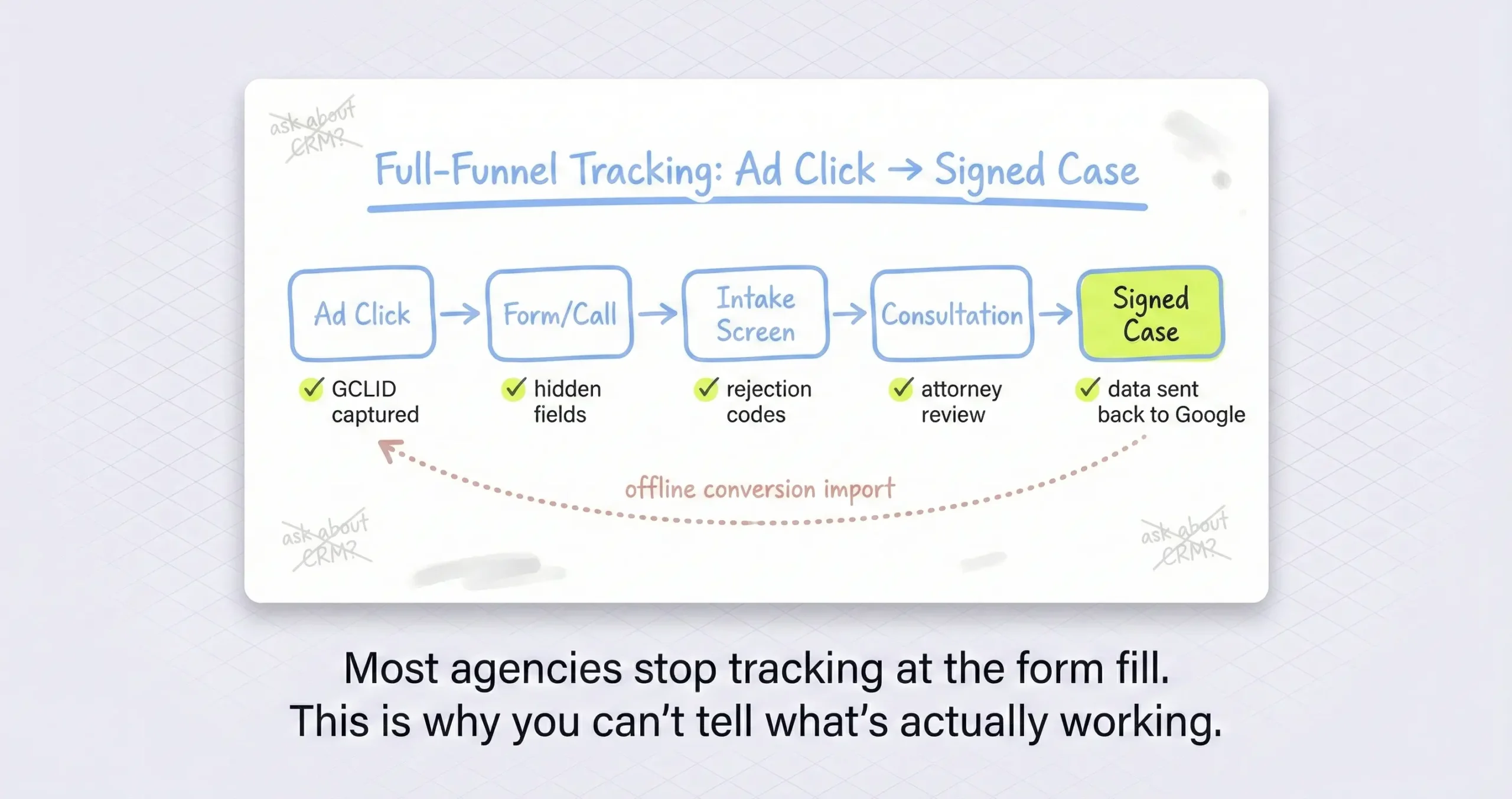
How do you track marketing leads all the way to a signed case? You capture a unique identifier from the ad click, attach it to every form submission and phone call through hidden fields and call tracking, carry it through your CRM as the lead moves from intake to screening to consultation, and then when the retainer gets signed you send that data back to the ad platform so the algorithm learns which clicks produce cases and which ones produce noise. Most agencies stop tracking at the lead. We track to the signed case and feed the outcome back to the source.
The number on your agency’s report and the number in your case management system are almost never the same, and the gap between them is where most of the wasted budget hides. An agency reports 150 leads at $80 each and calls it a great month. The firm looks at intake and sees maybe 2 or 3 signed cases out of those 150, which puts the real cost somewhere around $4,000 to $6,000 per signed case, and nobody is tracking that number because the agency’s job ended at the phone call and the firm’s tracking starts at the retainer and the middle just doesn’t exist.
The system I built works backward from the signed case instead of forward from the ad click. It starts with the question “which ad produced a client who actually hired us” and then traces the answer back through intake, through the form or the phone call, through the landing page, all the way to the keyword and the campaign that started it. And what that looks like in practice is what I want to walk through here, because the individual pieces aren’t complicated but connecting them so the data flows from click to signed case without breaking is the part that most setups get wrong.
Why Cost Per Lead Is the Wrong Number
Why is cost per lead misleading for law firms? Because a lead is just a phone call or a form fill. It doesn’t tell you whether the person has a case, whether they’re in your jurisdiction, whether the statute has expired, or whether they can even afford to proceed. In high-rejection practice areas like med mal, the industry data shows that up to 90% of inquiries are from people who are unhappy with a medical outcome but don’t have a legal claim. If your agency reports 100 leads at $100 each and none of them sign, your cost per signed case is infinite and your agency is going to call it a successful month because their metric stopped at the lead.
I didn’t understand this at first either. The marketing reports looked fine and the phones were ringing but the attorneys kept saying the leads were bad, and for a long time I thought one side was wrong. What I eventually figured out is they were both looking at different numbers; the agency was counting calls and the attorneys were counting cases, and nobody had a system that connected the two.
That disconnect is what this whole tracking architecture is designed to fix. The number that matters is cost per signed case, and you can’t calculate that unless you can trace a signed retainer all the way back to the specific ad click that started the conversation, which is harder than it sounds because there’s usually weeks between the click and the signature and the data passes through three or four different systems along the way.
How We Connect the Click to the Case
What is GCLID tracking and how does it work for law firms? When someone clicks a Google ad, Google attaches a unique identifier to the URL called a GCLID. That string contains encoded data about the keyword, the campaign, the ad copy, the device, the time, and the location. In most law firm setups that identifier hits the landing page and disappears. Our system captures it immediately through a script, stores it in a cookie so it follows the user as they browse the site, and injects it into a hidden field on every form. When the form gets submitted, the GCLID travels into the CRM alongside the person’s name and phone number, and it stays attached to that contact record through every status change from new lead to intake review to consultation to signed case.
The way it works on the form side is that when someone lands on the site from an ad, a small script grabs the tracking code that Google attached to the click and tucks it into a hidden field on the contact form. The person filling out the form never sees it, but when they hit submit, their name and phone number travel into the intake system with that tracking code riding along. So when the case gets signed three weeks later, we can trace it all the way back to the specific keyword and campaign that produced the original visit.
For phone calls there’s no form to carry that code, so the tracking works differently. The site shows a different phone number to each visitor based on how they arrived, and when someone dials that number the call gets tied to their browsing session automatically. Whether someone fills out a form or picks up the phone, the click data follows them into intake and stays attached through every status change until the case signs or gets rejected, which is what makes it possible to answer “which ad actually produced this client” instead of just “which ad produced a call.”
What Happens After the Lead Comes In
How does intake screening improve lead tracking for law firms? The intake screen is where the tracking system actually produces value, because this is where you find out whether a lead is a real case or not. Our intake process tags every lead with a status and a reason; qualified, disqualified with reason code, or needs attorney review. The reason codes are standardized; statute expired, no liability, damages below threshold, already represented, no contact after multiple attempts. That rejection data feeds directly back into the ad targeting because if 50% of leads from a specific campaign are getting rejected for the same reason, that’s a signal to change the ad copy or the targeting, not to buy more of the same leads.
This is the part that I think makes the biggest difference and it’s the part most agencies never see. When you’re inside the firm doing intake you learn things about lead quality that no dashboard can show you; you learn that the people coming from one campaign are mostly asking about incidents from 5 years ago, or that another campaign is pulling people from a zip code where the defendants are all uninsured, or that a keyword that looks great on paper is attracting people who want free advice and don’t have a case.
I was the person doing intake and running the marketing at the same time, which meant I could see both sides of the data in real time. Most firms don’t have that, which is why the rejection codes matter so much; they’re the bridge between what the intake team knows and what the marketing team needs to hear, and without standardized codes that data stays in someone’s head or in scattered notes that never make it back to the person managing the ads.
Feeding Signed Cases Back to Google
What are offline conversion imports and why do law firms need them? When someone buys something online, Google can see the purchase happen on the thank-you page. When someone signs a legal retainer, that happens offline; via phone, in person, or through a DocuSign days or weeks after the initial click. Offline conversion imports let you upload that retainer data back to Google matched to the original click identifier. Google then knows which clicks produced signed cases, not just which clicks produced form fills, and the bidding algorithm starts optimizing for the outcome that actually matters.
This is probably the most important technical piece and it’s the one almost nobody does. I set it up because I got tired of Google’s algorithm optimizing for leads when what I actually wanted was signed cases. The algorithm is smart but it can only optimize for what you tell it to measure, and if you’re telling it “a form fill is a conversion” it’s going to find you the cheapest form fills it can, which are usually the lowest quality inquiries.
When you feed signed case data back, the algorithm starts to see patterns you can’t; it might notice that signed cases come disproportionately from mobile clicks between 6 and 9pm, or from a specific set of zip codes, or from users who searched a very specific long-tail term. You’d never find those patterns manually but the algorithm will find them and shift the bidding accordingly, and the difference in lead quality after a few months of this feedback loop is noticeable in a way I honestly didn’t expect when I first set it up.
What Our Dashboard Actually Shows
What should a law firm marketing dashboard track? The dashboard should show cost per signed case by channel, not cost per lead. It should show the rejection rate by campaign with breakdown by reason, the time between lead submission and first contact, the conversion rate from qualified lead to signed case, and the projected pipeline value of signed cases for the period. If your agency’s dashboard shows impressions, clicks, and cost per lead but doesn’t show how many of those leads actually signed, you’re looking at an advertising report, not a business report.
I don’t show clients their impression count or their click-through rate because those numbers don’t tell you whether the marketing is working. A campaign can have great click-through rate and produce zero cases, and a campaign can have mediocre click-through rate and produce your best cases of the quarter, and you won’t know the difference unless your dashboard connects the ad spend to the signed retainer.
What I actually look at every week is the cost per signed case by campaign, the rejection reasons by campaign, and the time between form submission and first contact. Those three numbers tell me whether the targeting is right, whether the leads are real, and whether the intake process is catching them fast enough.
Everything else is noise that makes reports look busy without telling you anything you can act on, and I’ve been on both sides of that; I’ve been the person sending the busy reports and I’ve been the person receiving them and wishing someone would just tell me the real numbers, which is why our reports look different.
Why Med Mal and PI Need Different Tracking
Should medical malpractice and personal injury cases be tracked differently? Yes, because the timelines and rejection patterns are nothing alike. In PI the funnel moves fast; a lead comes in, intake qualifies them in a day or two, and the retainer gets signed within a week. In med mal the lead comes in and then sits in review for weeks or months while medical records get pulled and experts evaluate standard of care. If you measure med mal campaigns the same way you measure PI campaigns you’ll cut budget from campaigns that are working but haven’t had time to produce signed cases yet, and that’s a mistake I’ve seen happen when the tracking system doesn’t account for the practice area’s natural timeline.
For PI the metric that matters most is speed; how fast leads get contacted, how fast they move through intake, how fast the retainer gets signed. The research shows a 90% drop in qualification when response time goes beyond 5 minutes, and in a practice area where the competition is calling the same person, that speed is the difference between signing the case and losing it.
For med mal the metric that matters most is the rejection analysis, because the rejection rate is so high. The industry data suggests that up to 90% of med mal inquiries come from people who are upset about a medical result but don’t have an actionable claim. So the tracking has to distinguish between “this person doesn’t have a case” which is a targeting issue, and “this person has a case but we couldn’t reach them” which is an intake process issue, and those require different fixes.
Want to see what your leads are actually costing per signed case?
I can look at your current setup and tell you where the tracking breaks. If it turns out you’re already capturing the right data, I’ll tell you. If there’s a gap between your ad spend and your signed cases that nobody’s measuring, you’ll know where it is.