

What counts as a qualified legal lead? A qualified lead is one that meets the specific legal and financial criteria required for a firm to accept the case, not just a person who filled out a form or stayed on the phone for 60 seconds. The definition changes by practice area; in personal injury it means clear liability, documented injuries, and an insured defendant. In mass tort it means confirmed product exposure and a matching injury signature. In medical malpractice it means a breach of standard of care severe enough to justify the litigation costs. In family law it means the person can afford a retainer. Your marketing agency’s definition of “lead” probably stops at “someone called and didn’t hang up within a minute,” and the gap between that definition and yours is where most of your marketing budget disappears.
“The leads are bad” is the most common complaint in legal marketing and it’s almost never the right diagnosis. What’s usually happening is that the agency is sending people who have real legal situations that just don’t match what the firm actually handles, because nobody gave the agency specific enough criteria to filter against. The agency thinks a lead is someone who called about a legal matter. The firm thinks a lead is someone who has a case they want to take. Those are two different definitions and the gap between them is where most of the frustration and most of the wasted budget lives.
And closing that gap isn’t a marketing fix, it’s a vocabulary fix. It means telling the agency not just “we do personal injury” but “we take car accidents with clear liability and minimum $50,000 in medical bills, we don’t take slip and falls, we don’t take cases older than a year, and if someone calls about a dog bite send them somewhere else.” That level of detail sounds obvious but I’ve seen enough firms operate without it to know that the default is vague, and when the input to the agency is vague the output is going to be noisy, and then everyone blames the channel instead of the brief.
What Your Agency Counts as a Lead vs What You Count as a Lead
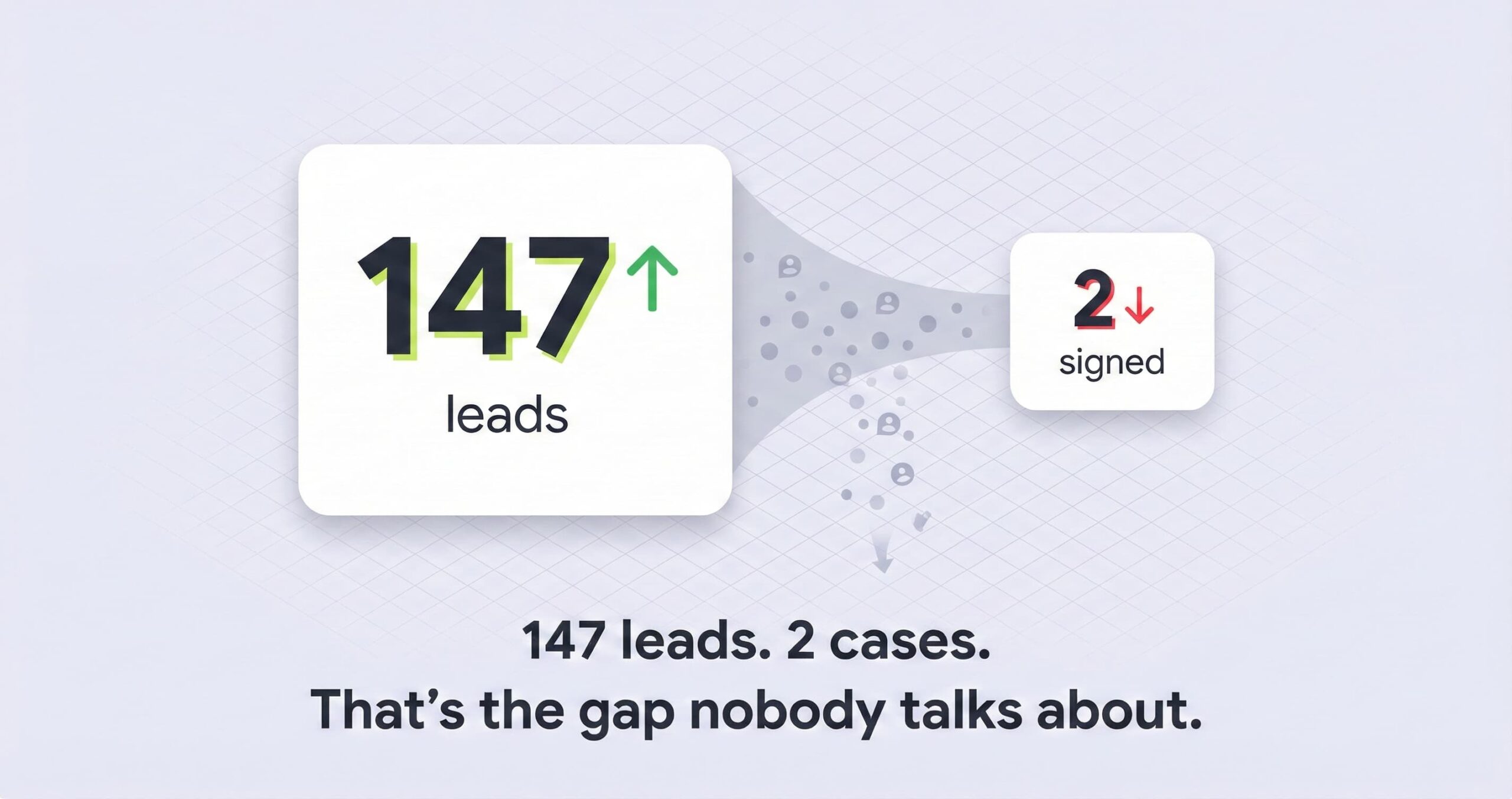
Why do marketing agencies and law firms disagree about lead quality? Because they measure different things. An agency operating on a cost per lead model gets paid when someone fills out a form or stays on a call for 60 to 90 seconds. Their incentive is to drive volume at the lowest cost, which means broad keyword targeting, wide geographic nets, and counting every contact event as a deliverable. The law firm gets paid when a case signs and resolves, which means they need leads that meet specific legal criteria for jurisdiction, liability, damages, and financial viability. When an agency reports 100 leads at $50 each and calls the month a success, and the firm signs 2 cases and calls it a failure, both sides are technically right by their own definitions, and that’s the core of the problem.
I see this play out the exact same way every time. The agency sends a report showing they delivered 150 leads at $60 a piece and they’re genuinely proud of that number because $60 CPL in personal injury is competitive and they worked hard to get it there.
The managing partner looks at the same month and goes “I spent $9,000 and signed two cases” which means his actual cost per signed case was $4,500, and if his average case settles for $15,000 on a 33% contingency fee that’s roughly $5,000 in revenue per case, which means he barely broke even on the marketing after you factor in overhead.
The problem isn’t that the agency is lying; those 150 people really did call or fill out a form. The problem is that 148 of them were either out of jurisdiction, already had an attorney, had no insurance on the other driver, had an accident that happened four years ago, or wanted help with something the firm doesn’t handle. And the agency counted every single one of those as a delivered lead because their definition stopped at “contact event happened” and never got to “is this actually a case we can take.”
What Actually Qualifies a Lead by Practice Area
What makes a lead qualified in personal injury, mass tort, medical malpractice, and family law? Each practice area has different “kill criteria” that immediately disqualify a prospect. In PI it’s the three-legged stool of liability, damages, and insurance coverage; remove any leg and the case is dead. In mass tort it’s product identification and a matching injury signature; general cancer from Roundup exposure doesn’t qualify because the science specifically links it to Non-Hodgkin’s Lymphoma. In medical malpractice many states require a certificate of merit from a medical expert before the case can proceed, and litigation costs mean firms typically only accept catastrophic outcomes. In family law the primary filter is financial; can the person pay a retainer, and are there assets worth dividing.
And what I want to do here is give you the specific questions that separate a real lead from a waste of time in each practice area, because most agencies don’t know these distinctions and most firms never spell them out clearly enough for the agency to filter on.
For personal injury the three things that have to be true are clear fault on the other party, medical treatment that’s documented not just “my back hurts,” and an insured defendant or UM/UIM coverage on the claimant’s own policy. If the person rear-ended someone else, or they’re sore but never went to a doctor, or the other driver had no insurance; any one of those and the lead is dead.
And the statute of limitations kills more leads than agencies realize because a caller whose accident was three years ago in a state with a two year filing deadline isn’t a lead, it’s a missed opportunity that nobody should be paying for.
For mass tort the specificity bar is even higher. A person who says “I used weedkiller and got cancer” is not a qualified Roundup lead; they need to have used Roundup specifically, for a documented period of time, and developed Non-Hodgkin’s Lymphoma specifically. And because mass tort marketing is so aggressive the dual representation problem is constant, where people sign with multiple firms without realizing it, and any intake process handling mass tort leads needs to ask about prior representation on the first call.
Medical malpractice is the most expensive to qualify because a bad outcome doesn’t mean malpractice. Patients call constantly because something went wrong after surgery, but if the complication was listed on the consent form they signed, that’s generally not a case. And in states like Florida the attorney has to get a medical expert to certify the claim has merit before they can even file, which means a “lead” isn’t really qualified until a preliminary medical review happens, and most agencies have no idea that requirement exists.
Family law is the simplest filter but agencies miss it constantly; can the person pay a retainer. If a firm charges for the initial consultation at $200 to $500 and the agency is promising “free consultation” leads, that mismatch creates angry callers and wasted intake time from the start. Beyond ability to pay, the value of a family law lead correlates to contested versus uncontested and whether there are significant assets or custody disputes involved.
The Math on Why Cheap Leads Cost More Than Expensive Ones
Why is cost per lead a misleading metric for law firms? Because a $30 lead with a 2% conversion rate costs $1,500 per signed case, while a $200 lead with a 20% conversion rate costs $1,000 per signed case. The “expensive” leads are actually 33% cheaper in terms of the number that matters, which is cost per signed case. On top of the wasted media spend, every unqualified lead costs roughly 10 minutes of intake staff time. If an agency delivers 80 bad leads out of 100, that’s over 13 hours of lost productivity per month at your intake desk, plus the morale damage of your team spending most of their day being told no or dealing with confused callers who never intended to hire an attorney.
And this is the math that changes how you evaluate your marketing budget because once you see it you can’t unsee it. An agency pitching you on $30 leads sounds incredible until you realize you’re signing one case out of every fifty contacts, and an agency charging $200 per lead sounds outrageous until you realize you’re signing one out of every five.
The cost that nobody puts on the dashboard is your intake team’s time and sanity. If 80% of the leads coming in are unqualified, your intake people are spending most of their day on calls that go nowhere, and that’s how you lose good intake staff, and then you’re paying to recruit and train replacements, and the whole time the leads keep coming in and nobody’s answering them fast enough because you’re short-staffed from the turnover the bad leads caused in the first place.
How to Fix This Before You Fire Your Agency
How can a law firm improve lead quality from their marketing agency? Write a Service Level Agreement that defines exactly what counts as a billable lead using practice-area specific criteria, not just “someone who called.” Include geographic restrictions by zip code, explicit case type exclusions, statute of limitations cutoffs, and a clear return policy for leads that don’t meet the definition. Then redesign your intake script to ask the disqualifying questions first instead of last, so you stop spending 15 minutes on a narrative before discovering the case isn’t viable. The firms getting the best results are the ones that told their agency exactly what to filter for and then built an intake process that catches whatever the agency misses.
The fix for this isn’t to fire your agency and find a new one, because the next agency will have the same incentive structure unless you change the rules of the relationship. The fix is to write down your definition of a qualified lead in terms specific enough that a 22 year old intake coordinator or an AI chatbot could apply them consistently, and then make that document part of your agency contract.
For PI that means telling the agency “do not send me leads where the caller was at fault, where there’s no medical treatment, where there’s no insurance, or where the incident is past the statute of limitations in the relevant state.” For mass tort that means “do not send me leads who can’t name the specific product or who don’t have the specific diagnosis.”
Then you build a return policy into the agreement where you can credit back leads that clearly fail those criteria, and if the agency pushes back on a return policy that’s probably the biggest red flag of all because it means they don’t trust their own lead quality enough to stand behind it.
On your side, redesign the intake script to ask the kill questions in the first 60 seconds. “Were you at fault?” “Do you already have an attorney?” “When did this happen?” If the answer disqualifies the caller, end the call politely and move on. There’s no reason your intake person should be taking a 15 minute narrative before discovering the accident happened in 2019 in a state with a two year statute, and that’s something you can fix today without spending another dollar on marketing.
Want to know how many of your current leads actually qualify?
I’ll pull your last 90 days of lead data, apply the practice-area criteria above, and show you what your real cost per signed case is versus what your agency is reporting. If it turns out your leads are fine and your intake is the problem, I’ll tell you that too because it’s a cheaper fix.