

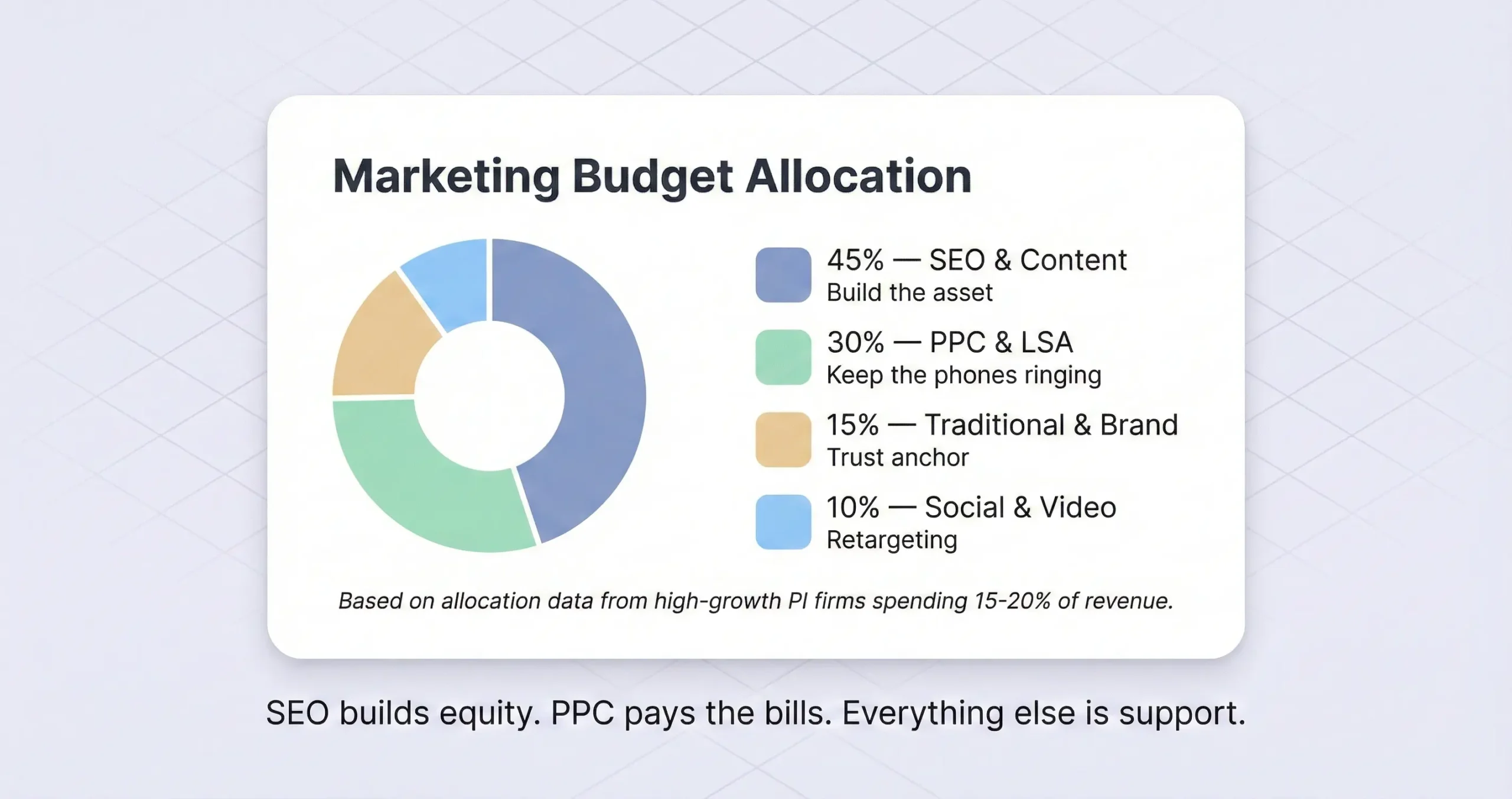
How much should a personal injury law firm spend on marketing? High-growth PI firms allocate 15 to 20% of gross revenue to marketing, which is two to three times what most other practice areas spend. The reason is the cost of acquisition; in competitive markets a single signed PI case costs $2,500 to $3,500 to acquire through paid channels, and if the average case generates $15,000 in fees you need a significant volume of new cases just to maintain revenue, let alone grow. The allocation that the data supports for PI specifically is roughly 45% toward SEO and content, 30% toward paid search and LSAs, 15% toward traditional and brand channels, and 10% toward social media and retargeting.
At Percy Martinez the marketing budget was a number that made me uncomfortable for the first couple of years because it felt like a lot compared to what other types of firms were spending, and I kept asking whether we were overspending until I ran the math backward from the case targets and realized we were actually underspending for what we were trying to accomplish.
The PI market is a different animal from family law or estate planning where you can build a practice on referrals and a decent website. In PI you’re competing against firms spending $30,000 or $50,000 a month on Google Ads alone, and if your budget isn’t at a level where you can actually show up in the results then the money you are spending is wasted because there’s no ROI for being invisible.
I wrote a broader piece on law firm marketing budgets across all practice areas but this post is specifically about PI because the economics are different enough that general budget advice can actually hurt you.
Why PI Requires 15-20% and How to Calculate the Exact Number
Why do personal injury firms need to spend 15-20% of revenue on marketing? Because the customer acquisition cost in PI is the highest in the legal industry. Cost per click for terms like “car accident lawyer” runs $100 to $300 in competitive metros, cost per lead lands between $200 and $500, and with intake conversion rates of 10 to 20% the cost per signed case hits $2,500 to $3,500. A firm generating $5 million in revenue that wants to grow to $7 million needs roughly 133 new cases at $15,000 average value, which at $3,000 per case requires $400,000 in incremental marketing spend before you count the base budget needed to maintain the existing $5 million. That’s the math that pushes PI firms into the 15 to 20% range while estate planning firms can run on 5%.
The better way to set the budget than using a percentage is to calculate it backward from your goals. Start with the revenue target, divide by your average case fee to get the number of cases you need, multiply that by your historical cost per signed case, and that’s your budget floor.
If your goal is $3 million in new revenue next year and your average PI case generates $25,000, you need 120 cases. If your cost per signed case is $2,500, the budget is $300,000. If your cost per signed case is $3,500, it’s $420,000. The percentage of revenue is a useful sanity check but the goal-based math is what tells you whether your budget is actually sized to achieve what you’re trying to accomplish.
Firms launching into a new geographic market or adding a mass tort division should expect the ratio to spike to 20 to 30% during the first 12 to 24 months because you’re buying market share from firms that have been there for decades, and the ROI won’t make sense during that period because it’s a penetration investment that pays off later.
Why 45% Goes to SEO and What That Actually Pays For
Why should PI firms allocate 45% of their marketing budget to SEO? Because SEO is the only channel where the cost per acquisition decreases over time. PPC costs rise with competition and inflation, but a page that ranks for “brain injury lawyer” generates leads at near-zero marginal cost once the initial investment in content and authority is recouped. For PI specifically, the SEO budget funds three things: content clusters that build topical authority around case types like trucking accidents or medical malpractice, technical infrastructure including site speed and mobile performance for people searching from accident scenes, and link building through digital PR campaigns that earn backlinks from local news outlets and medical publications.
The content cluster approach is the one I think matters most for PI firms trying to compete against incumbents with bigger PPC budgets. Instead of trying to rank for “car accident lawyer” on day one, you build a pillar page on trucking accidents and surround it with cluster pages about federal trucking regulations, jackknife accident fault determination, and commercial insurance limits.
Each cluster page answers a question that an accident victim or their family is searching for, and the depth of coverage signals to Google that your site has the expertise to rank for the broader commercial terms.
At Percy the content strategy was heavily medical-legal because that’s what the practice area demanded, and those pages did more than just rank. They acted as the first layer of intake by answering questions about case viability and fee structures before anyone picked up the phone, which meant the leads that did call were already informed and the conversion rate was higher than what paid search produced.
The technical and local SEO budget is the part firms tend to underinvest in because it’s not as visible as content. But PI clients are overwhelmingly mobile users searching from hospitals or accident scenes, and a slow site on a phone kills the experience before the content ever loads. Local SEO for the map pack requires managing Google Business Profiles, building citations, and generating a steady flow of reviews, and all of that costs money even though it doesn’t look like “marketing” on a spreadsheet.
The 30% PPC Budget and Why Precision Matters More Than Volume
How should PI firms allocate their paid search budget? The 30% PPC allocation covers Google Ads, Local Service Ads, and retargeting display. For PI the key is precision over volume because cost per click on broad terms like “injury lawyer” can exceed $300, which means amateur campaign management burns the budget in days. The budget should prioritize Local Service Ads first because the pay-per-lead model shifts risk away from the firm, then long-tail Google Ads targeting specific high-intent phrases, and finally retargeting display to stay in front of people who visited the site but didn’t call.
The paid search paradox in PI is that 78% of firms use it but 82% report underwhelming ROI, and the problem is almost always how the budget is managed, not whether PPC works as a channel. The firms that waste money are bidding on broad terms without negative keyword lists, sending traffic to the homepage instead of a dedicated landing page, and not tracking which clicks turn into signed cases.
Local Service Ads deserve a carved-out portion of the PPC budget because the economics are better for PI than standard search ads. You pay per lead instead of per click, the Google Screened badge adds a trust signal that improves conversion, and the leads tend to be higher intent because the ad format favors people ready to call. The strategy is to maximize LSA capacity first and then supplement with traditional PPC for broader keyword coverage and specific case types where LSAs don’t generate enough volume.
Long-tail targeting is where the real efficiency lives. Bidding on “hit by FedEx truck lawsuit” costs a fraction of “truck accident lawyer” and the person searching that phrase has a specific case with a specific defendant, which usually means higher intent and higher case value. At Percy we built campaigns around scenario-based keywords instead of broad practice area terms and the cost per signed case dropped while the case quality went up, which is the opposite of what most firms expect when they narrow their targeting.
The 15% Traditional Budget That Makes Everything Else Work Better
Why should PI firms still spend on billboards, radio, and TV in 2026? Because traditional media acts as a trust anchor that lifts the performance of every digital channel. Data shows that firms with strong offline brand presence see higher click-through rates on their Google Ads and higher conversion rates on their websites. When someone has seen your face on a billboard or heard your name on the radio and then sees your ad on Google, they’re more likely to click and more likely to call because the digital interaction feels less risky. The 15% traditional allocation also now includes Connected TV and streaming ads, which offer the storytelling format of television with the targeting precision of digital.
The billboard effect is real and I watched it play out at Percy. When we had outdoor media running in a market the paid search performance improved without any changes to the campaigns themselves, and when the outdoor came down the click-through rates drifted back to baseline. You can’t always attribute it cleanly because someone who saw a billboard last week and then searched your name today doesn’t leave a clear data trail, but the pattern was consistent enough that we stopped questioning whether the offline spend was worth it.
Connected TV is the piece of this allocation that’s changing fastest. Unlike broadcast TV where you’re paying to reach everyone in a metro whether they’re your audience or not, CTV lets you target specific households based on geography, income, and browsing behavior. For PI firms doing educational awareness campaigns around mass torts or product recalls, a 30-second unskippable ad on Hulu can explain a complex liability theory in a way that a static banner ad never could.
The 10% Social Budget and Why It’s Not About Acquisition
Should PI firms use social media for client acquisition? Not directly. People don’t search for a lawyer on Instagram or TikTok the way they search on Google. The 10% social allocation serves two purposes: retargeting people who already visited your website with testimonials, case results, and educational content, and creating short-form video that can reach local audiences through the algorithm without paid promotion. For educational awareness firms handling mass torts or product liability, social is where you reach problem-unaware victims who don’t know yet that their injuries might be connected to a product or drug.
The retargeting function is straightforward. Since 96% of website visitors leave without converting on the first visit, social retargeting keeps your firm in front of them while they’re still deciding. A Facebook ad showing a client testimonial that appears two days after someone visited your trucking accident page is a gentle reminder that costs a fraction of a new Google Ads click.
The educational video content is different because it’s not targeting people who already know they need a lawyer. Someone watching a 60-second TikTok explaining “three things not to say to insurance adjusters” might not have a case right now, but when they do they’ll remember the attorney who gave them useful information for free.
And for mass tort campaigns where the client might not even know the drug they took was recalled, social is the channel where you ask the question they haven’t asked themselves yet. “Did you use this product and experience these symptoms” is a different kind of marketing than anything Google Ads can do, and it requires a different budget approach than demand capture.
Want to know if your PI budget is sized right?
Send me your revenue target, your average case value, and your current monthly spend. I’ll run the war chest calculation and tell you whether you’re funded to hit the target or leaving cases on the table. If the budget is already right I’ll say so.