

What hidden fees do legal marketing agencies charge?
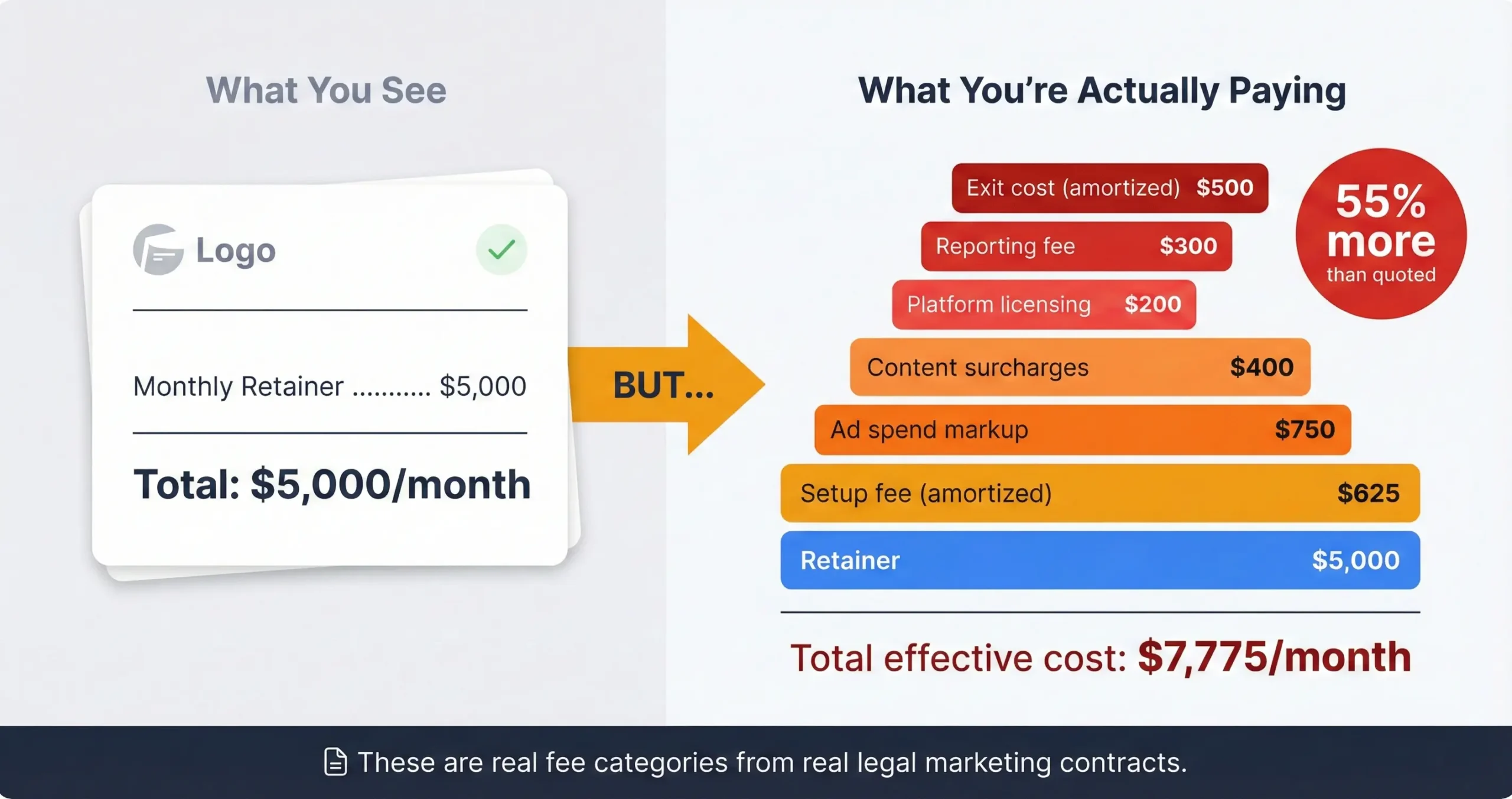
Fee Typical Range When You Find Out Setup / onboarding $1,000 – $7,500 Before work starts Ad spend markup 15-50% of your ad budget Usually never (buried in blended billing) Content writing surcharges $75 – $500 per piece When you ask why the blog posts stopped Platform licensing pass-through $200 – $500/month Buried in the invoice as “technology fee” Reporting / analytics access $250 – $500/month When you ask to see your own data Early termination penalty 50-100% of remaining contract When you try to leave Asset release / website buyout $1,000 – $5,000 After you’ve already terminated These fees can inflate the effective cost of a legal marketing engagement by 30-60% beyond the quoted retainer, and most of them aren’t mentioned during the sales process.
Your retainer is $5,000 a month and that’s the number you approved and that’s the number you see on the invoice, but if you actually sat down and added up everything you’re paying for the agency relationship including the stuff that shows up as separate line items or gets buried in “blended billing” or doesn’t appear until you try to leave, the real number is probably somewhere around $6,500 to $8,000 and nobody sat across from you during the sales call and said that out loud.
I think that’s maybe the most common complaint I hear from firms switching agencies, that the total cost of the relationship was way more than the retainer they agreed to and nobody told them until it was too late, which I guess I understand from a business standpoint but it still bothers me or whatever.
And I’m not saying every agency is scamming you, most of these fees are technically disclosed somewhere in the contract or the terms of service, but they’re structured in a way where you’d have to be reading every line of a 40-page MSA to catch them and the agency’s sales team isn’t exactly volunteering the information during the pitch meeting because their job is to get you to sign not to talk you out of it.
The Setup Fee That Subsidizes Their Sales Team
Typical range: $1,000 – $7,500
I’ve probably reviewed something like 35 or 40 agency contracts since I started doing this and the setup fee is always the first thing that looks off, because it’s supposed to cover the technical work of configuring your analytics and connecting your CRM and running the initial site audit and some of that is real work that takes real time.
Honestly though a $5,000 setup fee for a small firm usually includes a big chunk that’s just the agency recovering what they spent to acquire you as a client and their sales commissions and their marketing costs all get baked into a number they call “onboarding” and you’re essentially paying for the privilege of being sold to, which is a weird situation when you think about it.
The thing I always tell people to ask is whether the setup fee buys you anything you can take with you, like if they produce a technical audit and a competitive analysis and a strategy document and those belong to you as deliverables then that’s different from paying $3,000 for them to create accounts and have an internal kickoff meeting.
Like if you ask “what do I own after the setup phase” and they can’t point to specific documents then a decent portion of that fee is probably just overhead they’re passing to you, which apparently is a lot to ask.
The waived setup fee trap: Watch out for when they offer to waive the setup fee if you sign a twelve-month contract, because the setup fee usually reappears as a “recoupment charge” in the early termination clause. It was never actually waived; it was just converted into a reason you can’t leave without paying it anyway. I’ve seen this maybe a dozen times and I still don’t understand why more attorneys don’t catch it before signing.
The Ad Spend Markup You’re Not Supposed to Notice
Typical range: 15-50% of your ad budget
This is the big one and honestly it’s the one that makes me the most frustrated because the math gets genuinely ugly and most firms never see it happening, and there are two billing models for ad spend and one of them is basically designed to hide how much the agency is actually taking.
In a transparent model the agency charges a flat management fee or a percentage on top of your ad spend and you pay Google or Meta directly with your own credit card, so you can see exactly how much went to ads and how much went to the agency, and there’s nothing hidden since the numbers are right there in your Google Ads account and on your credit card statement and I think this is how every agency should operate but most of them won’t do it voluntarily.
In a blended model though the agency charges one number, say $5,000, and says they’ll “handle everything” including the media buy, and you assume most of that money is going to Google but the agency might cap ad spend at $2,500 and keep $2,500 as margin, which means half your “advertising budget” never actually bought a single click and your real cost per lead is double what the report says, and I don’t know why this is still legal but it is.
How the math actually works:
You pay $5,000 thinking it’s for ads. Agency keeps $2,500. Only $2,500 reaches Google. You get 10 leads. Your agency reports a $500 CPA. But your real media efficiency is $250 per lead; the agency is charging you a 100% markup on the actual ad spend and you’d never know unless you saw the Google invoice.
The fix is almost embarrassingly simple: pay Google directly, give the agency admin access to the account, and pay their management fee separately. If they won’t agree to that arrangement it’s probably because blended billing is where their margin lives and they don’t want you to see the split, which I think tells you everything you need to know.
Content Writing Charged Separately From the Retainer
Typical range: $75 – $500 per piece
Your retainer covers “content marketing” according to the proposal, but maybe three months in you notice the blog hasn’t been updated and when you ask about it the agency says content production is billed separately at $150 to $500 per article depending on length, and now you’re looking at an additional $600 to $2,000 a month for four posts that were implied in the pitch but technically excluded in the scope of work, and honestly I’ve watched this exact conversation happen so many times I could probably script it.
But the hidden cost that’s even worse than the invoice is the quality problem, because $75 legal blog posts are written by non-lawyer generalists who confuse robbery with burglary and cite repealed statutes, and then your managing partner has to spend 90 minutes correcting each one, and if that partner bills at $400 an hour the real cost of a “$75 blog post” is $675 once you factor in the attorney time tax, which nobody ever calculates but probably should.
The 9x multiplier:
- Invoice cost of the blog post: $75
- Attorney review time (90 min at $400/hr): $600
- Real cost of the “cheap” content: $675
Worst version of this is when the agency syndicates the same generic article to dozens of law firm websites with only the city name swapped out, which Google’s algorithms now actively penalize as thin duplicate content, meaning you paid for something that’s actually making your site worse and I’ve never gotten a good answer from anyone on why agencies keep doing it except that it’s profitable for them.
Platform Licensing Passed Through at a Markup
Typical range: $200 – $500/month
Somewhere on your invoice there’s a line item called “technology fee” or “platform access” or “marketing software” and it’s maybe $300 to $500 a month, and what that usually covers is the agency’s subscription to tools like CallRail or SEMrush or their reporting dashboard, and they’re paying wholesale rates of maybe $50 to $100 per client and marking it up 300 to 400 percent, which I think is probably the most common hidden fee I see and also the easiest one to negotiate away if you just ask about it.
But where this gets actually dangerous with call tracking is the ownership question, like whether the agency owns the account or you own the account, because if they own it and they put that tracking number on your Google Business Profile and your business cards and your directory listings, then when you leave the agency the phone number leaves with them.
I had a firm reach out to me earlier this year dealing with exactly this and every past client and referral source who had that number was reaching a dead line, and they lost probably three weeks of incoming calls during the transition, which is the kind of thing you don’t think about until it happens to you.
Same thing with review management platforms honestly, some agencies charge $200 to $500 a month for “reputation management” that’s just a white-labeled version of software that costs $50 direct, and sometimes the reviews get collected on a proprietary microsite instead of going directly to Google which means your local SEO gets almost no benefit from the reviews you’re paying to generate, which is kind of insane when you think about it.
Reporting Fees For Access to Your Own Data
Typical range: $250 – $500/month
An agency charging you $250 to $500 a month for a “reporting fee” is charging you for an automated PDF that costs them almost nothing to generate, because tools like AgencyAnalytics or Looker Studio pull the data automatically and the agency is literally billing you for a document that a computer produced, and I honestly don’t know how they justify this with a straight face but I’ve seen it on maybe a third of the contracts I’ve reviewed.
What actually matters isn’t whether you should pay for reporting, it’s whether you have direct read-only access to Google Analytics and Google Ads and Search Console yourself, because if the only way you can see your own performance data is through a report the agency sends you once a month then you have no way to verify what they’re telling you and no way to catch discrepancies between what they claim and what actually happened, which seems like a pretty basic thing to want but apparently not.
If an agency says the data is “proprietary” or refuses to give you access to the source accounts, that’s not a reporting dispute that’s a transparency problem and it usually means there’s something in the raw numbers they’d rather you didn’t look at too closely, and if that’s your situation I think you probably already know what I’m going to say.
Early Termination Penalties That Make It Too Expensive to Leave
Typical range: 50-100% of remaining contract value
Say you signed a twelve-month contract at $5,000 a month and month four rolls around and the results aren’t there and you want out, and the termination clause says you owe 50 to 100 percent of the remaining contract value which is somewhere between $20,000 and $40,000, and the agency knows you’re not going to litigate over it so they send it to collections or offer a “settlement” of maybe half the penalty and you pay it because honestly what else are you going to do.
Their argument is that they’ve allocated resources and forecasted revenue around your contract, which I guess is true but the penalty is usually wildly disproportionate to their actual damages, and in some jurisdictions courts won’t enforce penalties that look more like punishment than compensation for real losses but litigating that distinction costs money too so most firms just pay or stay in contracts they want to leave, which is exactly what the clause was designed to accomplish.
Auto-renewal trap: Some contracts renew for another twelve months unless you give notice exactly 60 or 90 days before expiration. Miss the window by one day and you’re locked in for another year. I always tell people to calendar the non-renewal date the day they sign the contract, because nobody remembers to check 90 days before a renewal date and the agencies definitely know that.
The Asset Release Fee You Find Out About After You’ve Already Left
Typical range: $1,000 – $5,000
You terminate the contract and ask for your website files and the agency says sure, that’ll be $3,000 to $5,000 for the “website buyout” or “asset release fee,” and this is the first time anyone has mentioned this number because it wasn’t in the sales presentation it was on page 34 of the terms of service that nobody reads, and honestly this is the one that drives me the most crazy because by the time you find out about it you’ve already made the decision to leave and you have zero bargaining power.
And it gets worse when the agency built your site on a proprietary CMS instead of WordPress or another open-source platform, because in that case there’s nothing to “release” since the code belongs to them, and what you get is a folder of text files and maybe some images and you have to pay a new developer $5,000 to $15,000 to rebuild the entire site from scratch which means you’re paying twice for a website you already paid for once, and I don’t know maybe that’s technically fair from a contract standpoint but it doesn’t feel fair.
Domain ownership is the nuclear version of this where the agency registered your firm’s domain name under their registrar account, and if they hold the domain hostage during a termination dispute you lose your website your email and your entire digital identity until the dispute is resolved, which is why your domain should always be registered in your own name and the agency should only ever have DNS access not ownership, and if your agency owns your domain right now you should probably fix that this week before anything else.
Before you sign anything, ask these three questions:
- What do I own if I leave; the website code, the ad accounts, the phone numbers, the data?
- What does the total monthly cost look like including every fee, not just the retainer?
- What happens financially if I need to terminate at month four?
If the answers aren’t in writing, they don’t exist. And if the agency gets weird about putting this stuff in writing, that probably tells you something too.
Want someone to look at your current contract?
Send me your agency agreement and I’ll flag any of these seven fee categories that are buried in the terms, including what you’re probably paying versus what you should be paying. And if your current situation is actually fine I’ll tell you that too.