

Written by Jorge Argota · Legal Marketing · United States
Seven months into an SEO campaign I inherited from another agency, the managing partner called me and said he was ready to pull the plug because he’d spent $35,000 and signed zero cases from organic search, and when I pulled his Search Console data his impressions had gone from 400 to 11,000 and his main keyword had moved from page nine to page three. The campaign was doing exactly what a seven month old campaign is supposed to do but nobody had ever told him that page three at month seven is the step before page one at month twelve.
That firm stuck with it and by month fifteen their organic leads cost less than half of what their paid leads cost, and by month eighteen they cut ad spend by 40% and still signed more cases than the year before. But I’ve also watched firms quit at month six and turn $30,000 in foundation work into a total loss because the compounding phase was three months away and they never got to see it.
TL;DR
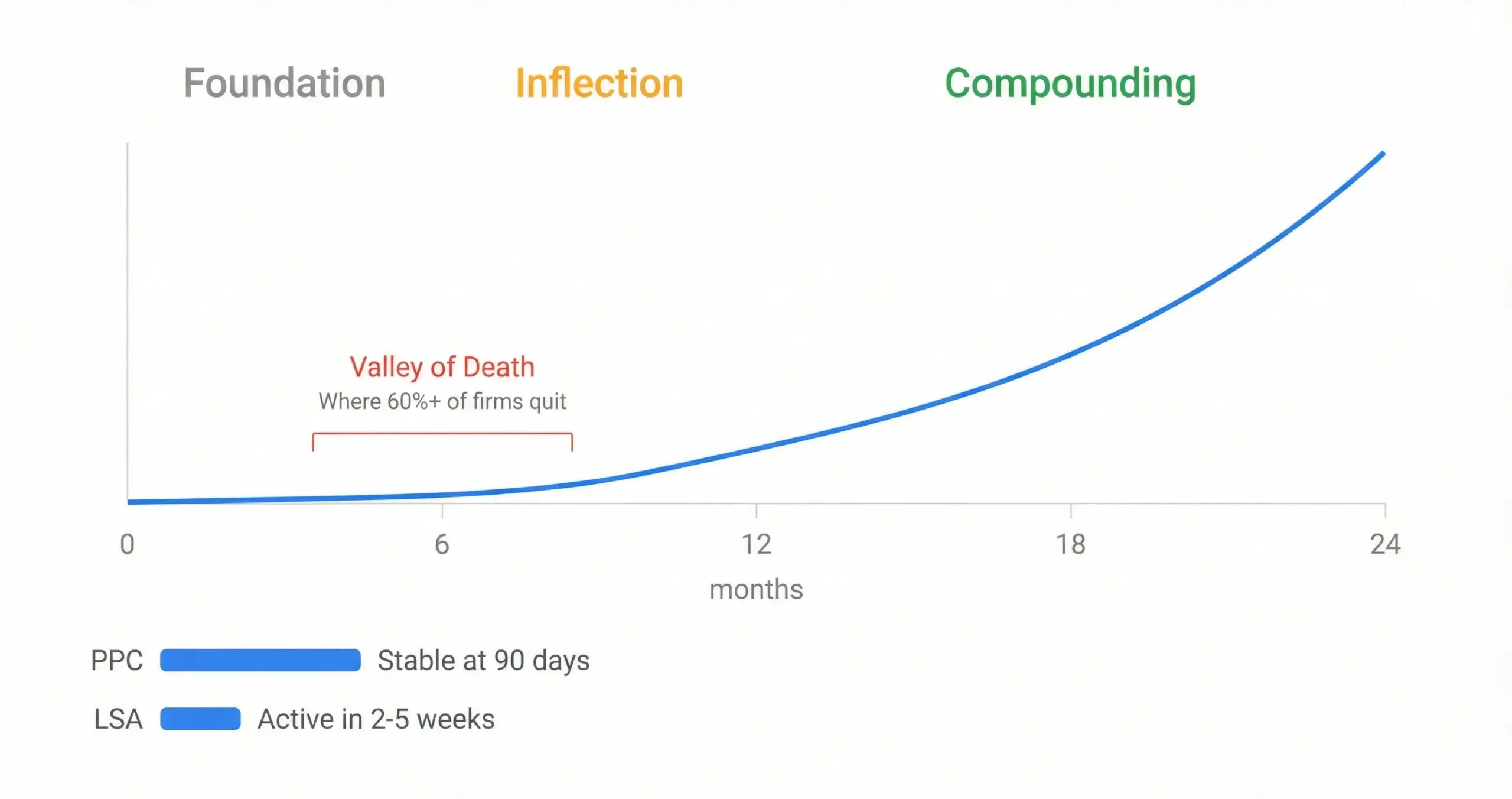
How long does law firm marketing take to work? SEO takes 3 to 6 months before rankings move, 6 to 12 months before the phone rings from organic, and 12 to 24 months before the cost per case drops low enough that the investment compounds. Google Ads produces traffic in hours but takes 90 days of optimization before cost per lead stabilizes. Local Service Ads are the fastest route to a ringing phone; usually active within 2 to 5 weeks. Most firms quit SEO between months 4 and 9, which turns everything they spent into a total loss. Source: Jorge Argota, campaign data from hundreds of law firm audits.
MONTH ONE IS MOSTLY BREAKING THINGS APART BEFORE ANYTHING GETS BUILT
Month one is ugly and nobody celebrates any of it. Your agency is running crawls to find broken links and 404 errors and mixed content issues, restructuring the site so pages aren’t buried six clicks deep, and fixing load speed problems that make the site feel slow on mobile, and none of that shows up on any chart or graph that a partner would recognize as progress.
Schema markup goes in during this phase, and what that means in plain English is that code gets added to the back of the site telling search engines “this is a law firm, these are the attorneys, these practice areas are what they handle, this is where they’re located,” and without that code the search engine has to guess what the site is about instead of being told directly, which slows down the categorization process by weeks.
Your Google Business Profile matters more during this phase than the website itself. Getting the primary category right (selecting “Personal Injury Attorney” instead of the generic “Lawyer”), uploading real photos of the actual office, and populating the Q&A section with questions potential clients ask are all things that affect map pack rankings within weeks rather than the months it takes for the website to start moving.
AROUND WEEK FOURTEEN SOMETHING SHOWS UP THAT NOBODY OUTSIDE THE AGENCY NOTICES
You’re five months in and $25,000 deep and the phone hasn’t rung once from organic search and you’re starting to wonder if the whole thing is a scam, and I get it because that’s a rational response to spending money and getting nothing back, but what’s actually happening is that your site is being vetted by an algorithm that intentionally suppresses new or recently changed legal websites until it’s confident you’re legitimate.
Around week fourteen something shows up in Search Console that the agency gets excited about and nobody else cares about, which is that long-tail phrases like “what to do after a car accident in [county]” are appearing in the impressions report at positions 30 or 40, meaning Google is testing your pages in the results but so far back that no human being is scrolling deep enough to see them.
What the Partner Sees at Month 5
$25,000 spent. Zero cases from organic. Monthly report shows “keyword movement” and “impression growth” which sound like excuses. The phone hasn’t rung. Rational conclusion: this isn’t working.
What’s Actually Happening at Month 5
Impressions tripled from 500 to 1,500. Main keyword moved from position 45 to position 22. Long-tail phrases appearing in Search Console. The campaign is progressing exactly on schedule; page three at month five is the step before page one at month nine.
Link building has to start during this phase or the next one stalls. Directory submissions, a local charity sponsorship that earns a link from the organization’s site, responding to journalist requests through platforms that connect lawyers with reporters, all of it sends authority signals to the domain that the technical fixes and content alone can’t provide. Without links coming in between months three and six, the content sits on a domain that Google considers technically sound but not yet endorsed by anyone else.
BETWEEN MONTH SIX AND MONTH NINE THE PEOPLE CALLING YOUR OFFICE CHANGE
Somewhere around month seven the calls change, not the volume necessarily, not at first, but the type. Before month six you might get a handful of calls from people who found a blog post and wanted to ask a quick question, and those calls don’t convert because the person wasn’t looking for a lawyer, they were looking for an answer. After month six the search queries driving traffic shift from informational terms to commercial intent terms, which means the person typing the search is ready to hire someone, and that shift is when the investment starts converting to actual consultations.
Local map rankings almost always trail behind your organic website rankings by two to four months, which means the map pack visibility that drives the highest call volume for local firms is one of the last things to show up even when everything else is working. Review velocity matters here more than almost anything, so a firm that started generating reviews in month one sees map results around month nine while a firm that waited until month four is looking at month twelve or beyond.
The AI Overviews shift: By month nine you’ll notice something confusing in the data; impressions climbing fast but clicks not keeping pace, and that’s because Google’s AI Overviews are answering simple questions directly on the search results page so the user never needs to visit your site. Content that just defines a term or explains a basic process is losing its traffic value, while content that describes strategy, experience, or specific case outcomes retains its value because AI can’t authentically replicate “I’ve handled 200 of these cases and here’s what I’ve seen.” The AI search guide covers how to get cited instead of bypassed.
Conversion optimization replaces content production as the priority during this phase because a site getting 500 visits and producing 5 leads has a conversion problem, not a traffic problem. Testing whether a phone number at the top of the page performs better than a contact form, whether “Free Consultation” converts better than “Schedule a Call,” and whether shorter intake forms produce more completions than detailed ones are the decisions that determine how much revenue the existing traffic actually generates. The conversion guide has the full testing framework.
AT MONTH TWELVE THE MATH STARTS TO FEEL UNFAIR IN YOUR FAVOR
At twelve months, a new blog post published on Monday shows up in the top twenty positions by the end of the following week, and that’s a completely different experience from month three when the same quality post would sit at position 60 for four months before moving. The domain has earned enough authority that the search engine gives new content the benefit of the doubt instead of making it prove itself from scratch every time.
Month 3
$800
per organic lead. Low volume. Content still aging. Retainer feels expensive relative to output.
Month 14
$300
per organic lead. Volume tripled. Retainer stayed flat. A competitor entering now needs 12 months to reach where you already are.
Whether to scale or maintain depends on what the firm needs. A firm trying to expand into adjacent practice areas or neighboring cities can use the established domain as a launch pad where new content benefits from the trust the site already built. A smaller firm happy with its current caseload can shift to one or two quality posts per month and focus on case work, and the local authority protects them from new entrants without requiring the same intensity that the first year demanded.
THE VALLEY OF DEATH IS BETWEEN MONTHS FOUR AND NINE
Month six partner meeting, $30,000 spent across invoices, and the managing partner opens with “so where are the cases from this SEO thing” and the honest answer is that there aren’t any yet and there won’t be for another three to six months, and that answer goes over about as well as you’d expect.
Firing the agency at month eight doesn’t save you $5,000 a month. It turns the $40,000 you already spent into a complete write-off. Links that were building authority stop accumulating, content that was aging into relevance stops maturing, and the algorithmic momentum that was three months away from producing your first organic cases flatlines. You didn’t save money; you paid full price for a foundation and then demolished it before the building went up. And then what usually happens is the firm hires a different agency three months later, that agency starts from scratch, and the sandbox clock resets. I’ve seen firms cycle through three agencies in two years doing exactly this, spending $55,000 total with nothing to show for any of it.
GOOGLE ADS PRODUCES TRAFFIC IN HOURS BUT TAKES 90 DAYS TO STABILIZE
Week one of a Google Ads campaign might show a 13.9% conversion rate at $103 per lead, and week twelve of that same campaign running the same budget in the same market shows 36% at $52, and the difference is that the algorithm spent those twelve weeks learning which combinations of keywords, ad copy, time of day, and device type produce people who actually call instead of people who click and bounce. That first month of spend is tuition, not marketing.
Week 1
$103
per lead / 13.9% conversion
Week 12
$52
per lead / 36% conversion
You’re paying Google to figure out that “free lawyer” and “lawyer salary” and “how to become a lawyer” are searches that drain your budget without producing a single potential client, and each of those negative keywords you add based on actual data from actual wasted clicks makes the campaign more efficient for the next month, which is why campaigns that have been running for six months almost always outperform campaigns that just launched even if the new campaign has a bigger budget. The paid search guide has the full cost per click and optimization timeline.
LOCAL SERVICE ADS ARE THE FASTEST ROUTE TO A RINGING PHONE
A background check that takes two to five weeks and a star rating above 4.5, that’s the entire barrier between your firm and leads arriving tomorrow. Once LSAs are active they appear above everything else on the search results page, above the regular ads, above the map pack, above the organic results, which is why they’re the fastest route to a ringing phone for any firm that qualifies.
But Google caps your LSA volume, and this is the part most agencies leave out when they pitch it as a standalone strategy. Your budget determines a ceiling and so does the number of verified lawyers competing in your area code, so LSAs are almost never the whole answer for aggressive growth; they’re the fast channel that funds the slow channel while the slow channel builds. And your star rating isn’t just a nice-to-have; it’s the throttle that controls your visibility, so a firm that drops from 4.9 to 4.3 after a few bad reviews can see their lead flow cut by more than half even though they didn’t change their budget or their ad settings.
DIFFERENT PRACTICE AREAS RUN ON COMPLETELY DIFFERENT CLOCKS
When someone asks me how long marketing takes what they’re really asking is how long for their practice area in their market, because a criminal defense firm in a mid-size city and a personal injury firm in Los Angeles are operating on timelines that have almost nothing in common even though both of them are paying an agency to “do SEO.”
| Practice Area | SEO Timeline | Why |
|---|---|---|
| Criminal Defense | 3 to 9 months | Urgent intent. Mobile-first. Map rankings and LSAs matter more than long-form content. |
| Family Law | 6 to 12 months | Research-heavy clients. Educational content captures them early. Reviews matter intensely. |
| Estate Planning | 6 to 18 months | Lower competition, smaller budgets. $2K to $3K a month can produce real visibility because nobody else is investing seriously. |
| Personal Injury | 12 to 24 months | Most competitive vertical. Cost per click exceeds $300 in major metros. A firm at a lower budget should expect zero organic results for 12 months. |
| Business Litigation | 12 to 18 months | Depends on thought leadership. Low search volume but high case values. Content quality matters more than volume. |
A DUI client at 2 AM is searching from a holding cell or a family member’s phone and they’re not reading blog posts or comparing five firms; they’re calling whoever shows up first, which means criminal defense SEO is a sprint where the timeline to meaningful leads can be as short as three to four months in a market without heavy competition. Personal injury is the marathon that nobody signed up for, and a firm at the lower budget tier in a major metro should honestly expect zero organic results for twelve months because the competition density is that high.
THE BUDGET SHOULD SHIFT AS THE SEO MATURES
Most firms set a marketing budget in January and don’t touch the channel allocation for twelve months, which is exactly the wrong approach because the ratio between paid and organic should shift as the SEO matures. Months one through six should weight roughly 70% toward paid channels that produce immediate cases and 30% toward SEO that’s building the foundation, and then by month twelve the ratio should reverse because organic is now producing leads at a fraction of the paid cost and the paid budget becomes a precision tool for competitive terms instead of the firm’s primary lead source. The budget guide has the full channel allocation splits by firm type.
Months 1 to 6
70 / 30
paid / organic split
Months 6 to 12
50 / 50
paid / organic split
Month 12+
30 / 70
paid / organic split
And when a firm shows up in the LSA section at the top of the page and the PPC ad section in the middle and the organic results below, the user sees the same name three times before they’ve scrolled past the first screen, and at that point you’re not one option among many, you’re the only firm the searcher remembers. That triple presence increases click-through rates on all three listings because the brand becomes ubiquitous and the user perceives the firm as the market leader, which is why the blended approach isn’t just a bridge strategy for surviving the SEO foundation period, it’s the permanent architecture for total search dominance.
Publishing fifty AI pages in month two is the worst decision you can make. Google’s spam filters in 2026 are specifically calibrated to detect “AI-generated scale without information gain,” which means a hundred pages that all sound the same and contain no detail that couldn’t have been written by someone who’s never practiced law in your state will extend the suppression period rather than shorten it. Content that mentions your specific county courthouse by name, references the local judges, or explains the procedural quirks of your jurisdiction tells the algorithm something generic content can’t: this was written by someone who actually works here.
Want to know where your firm is on this timeline?
Send me your Search Console data and I’ll tell you whether the leading indicators match where you should be. If you’re in the Valley of Death and the numbers are actually progressing, I’ll show you the data that proves it. If the numbers aren’t progressing, I’ll tell you that instead.
Related: SEO for Lawyers · Paid Search for Law Firms · Marketing Budget by Firm Size · Complete 2026 Strategy Guide · Conversion Optimization · AI Search Visibility · Predictable PI Pipeline