

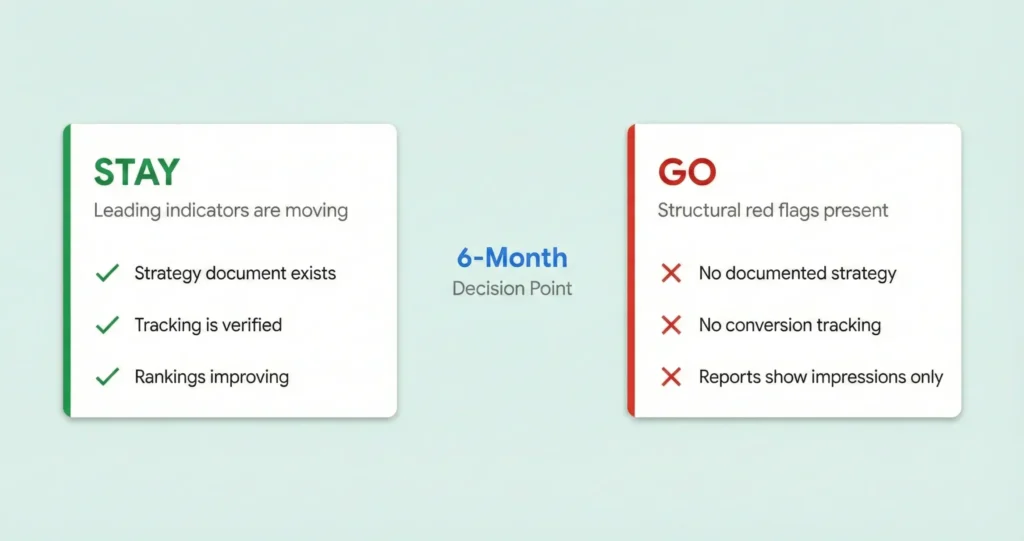





When should you fire your law firm marketing agency? Fire immediately if the agency has no written strategy document, no conversion tracking setup, or reports only on vanity metrics like impressions and social reach. Be patient if SEO is under 6 months old and leading indicators like keyword rankings, impressions, and indexed pages are trending upward with documented work logs. The decision framework: give SEO 6 to 12 months but demand monthly milestone reports proving the work and the direction, and fire without hesitation if the agency can’t produce either one. Source: Jorge Argota, legal marketing, Miami.
So you’re four months in and the phone still isn’t ringing and the agency keeps telling you “it takes time” and you’re sitting there thinking “is this actually working or am I just burning $5,000 a month for nothing” and honestly that exact question is the reason this post exists.
Here’s the thing that makes this decision so genuinely difficult; both scenarios look identical from the outside for the first three or four months, meaning an agency that’s building something real and an agency that’s building nothing at all will say the exact same words to you during month three, which is “we need more time,” and you can’t tell the difference yet.
But you will be able to, and the way you tell the difference is by looking at the signals instead of listening to the sales pitch, which I’m going to walk through because nobody else seems to want to put this in writing for some reason.
The Three Things That Mean You Should Fire Immediately
There’s a version of this conversation where I’d tell you to be patient, and we’ll get to that, but first I need to explain the three situations where patience is a waste of your money because the problem isn’t speed; the problem is that the agency never actually built anything.
No written strategy document.
Not the proposal or the contract or the slide deck they showed you during the sales call; I mean an actual strategy document that says who your ideal client is and what keywords you’re targeting and why and what the competitive landscape looks like in your specific market and what the roadmap is for the next six months.
If you’ve been paying for more than 60 days and nobody can produce this document, you should be asking yourself what exactly the retainer has been funding, because marketing without a strategy is just random activity that happens to cost money, and that’s not going to get better with time no matter what they tell you on the next call.
No conversion tracking infrastructure.
I had a firm reach out to me earlier this year and I was like “ok show me your call tracking dashboard” and they were like “our what” and they’d been paying an agency $6,000 a month for maybe seven months and the agency had never set up call tracking, never connected DNI to the landing pages, never built a dashboard connecting ad spend to actual leads.
The whole time this firm was just guessing about what was working and what wasn’t, which honestly made me wonder what exactly the agency was optimizing against because without data the answer is nothing.
Marketing without tracking is just spending, and I still don’t understand how agencies charge $5,000 or $6,000 a month and skip the one thing that makes everything else measurable, but it happens constantly and nobody seems to think it’s a problem until the money’s gone.
Reports that only show vanity metrics.
Say the monthly report shows up and it’s all impressions and social media followers and “total website traffic” but it never once mentions qualified leads or cost per lead or which cases came from which channel; that’s not reporting, that’s misdirection, and the agency knows the difference even if they’re hoping you don’t.
High impression counts with low conversion usually mean the targeting is wrong or the landing pages aren’t working or both, and an agency that leads with impressions instead of leads is hoping you’ll confuse activity for progress, which I guess works until someone explains the difference.
Any one of these by itself is enough to start the conversation about leaving, and all three together is honestly hard to explain away no matter what the agency says.
When Patience Actually Makes Sense
So here’s where I’d normally expect you to think I’m about to say “fire everyone” but actually the opposite is true in a lot of cases, and the thing that frustrates me most about this whole topic is that firms sometimes leave too early when the agency was genuinely doing good work that just hadn’t shown up yet.
The difference between “working but early” and “not working at all” comes down to whether you can see movement in the data even before the results show up in your bank account, and there are maybe five or six specific signals that tell you which situation you’re in.
| Signal | What It Means | Your Response |
|---|---|---|
| Keyword impressions in Search Console trending up | Google is starting to notice your content | Stay; this is the earliest sign of SEO traction |
| Rankings moving from page 4 to page 2 for target keywords | Authority is building; page 1 is within reach | Stay; most firms quit right before this turns into traffic |
| New pages getting indexed within days instead of weeks | Google trusts the site enough to crawl it frequently | Stay; this is the foundation compounding |
| Traffic up but leads flat | The content is attracting the wrong people or the conversion path is broken | Stay but demand a conversion rate audit within 30 days |
| Everything flat after 4 or 5 months with documented work | The strategy might be wrong even if the execution is solid | Have the hard conversation; demand a pivot proposal |
| Everything flat after 4 or 5 months with no documented work | You’re probably paying for nothing | Fire |
I keep having this conversation with attorneys where they say “my agency says to be patient but I have no idea what I’m being patient for” and the answer is that patience is only rational when you can point to something specific that’s trending in the right direction, and if the agency can’t show you any of these then patience isn’t a strategy it’s just hope, and hope doesn’t compound the way SEO does, which I wish more agencies would just say out loud.
What I’d Actually Check at Month 4
Imagine I’m sitting across from you right now looking at your laptop, here’s what I’d pull up and honestly most of this takes maybe an hour if you know where to look, and you don’t need anyone’s permission to check any of it.
First thing; your Google Search Console access, not the agency’s filtered screenshot but the actual account, because Search Console shows you exactly how many impressions and clicks your site is getting and which search queries are driving them, and if the agency hasn’t shared access to this that’s already telling you something about how transparent they plan to be.
What I’d be looking for is whether impressions have been trending up over the past 90 days even if clicks are still low, because that means Google is testing your pages in search results and clicks almost always follow within a few weeks, and this is honestly the most reliable early indicator I know of, which is why it frustrates me when agencies don’t show it to their clients without being asked.
Second; I’d go to the actual website and check whether the content the agency promised to publish actually got published, and I don’t mean asking them, I mean looking at the blog dates and page metadata myself, because agencies absolutely will bill for content that was never written or publish it three months late and then blame the SEO timeline, and those are completely different problems that deserve completely different responses.
Third; whether call tracking is connected and recording, because even if calls are slow right now the infrastructure needs to exist so that when things pick up you can trace every lead back to the campaign or keyword that generated it, and if the agency hasn’t done this by month four they’re not planning to close the loop between your spending and your revenue, and that’s a structural gap not a timing issue, which for some reason always takes longer to explain than it should.
The Conversation Before the Firing
Before you fire anyone you should have one very specific conversation, and I’d frame it exactly like this; “I need to see a written strategy document, proof that call tracking is operational, and a report showing qualified leads by source, and I need all three within 30 days or I’m going to start looking at alternatives.”
Then watch what happens next, because the response tells you everything.
If the agency gets defensive or starts throwing jargon at you or asks for more time without specifics, that’s your answer and honestly you probably already knew.
But if they come back with “here’s the strategy doc we should have shared three months ago and here’s the tracking data and here’s what we’re seeing in the numbers” then maybe the relationship is worth saving, and this does actually happen occasionally, usually because the agency was doing decent work but just terrible at communicating it, which I guess is its own kind of problem but a much more fixable one or whatever.
Even if you’re planning to leave I’d still have this conversation first, because the transition to a new agency takes maybe two or three months before they’re fully up to speed, and the gap between agencies is where a lot of SEO equity gets lost if nobody’s maintaining the site during the handoff, so you want to be sure before you pull the trigger on something that’s hard to undo.
What You Lose When You Fire Too Early
Something that honestly bothers me about the “fire your agency” advice you see all over LinkedIn and marketing Twitter is that nobody ever talks about what it costs to leave too early, and it’s not a small number.
Say you’ve been paying for SEO for five or six months and the foundation work is done and the rankings are starting to move from page four to page two and you fire the agency because the phone hasn’t rung yet; you’re basically throwing away everything you paid for, and I know that’s hard to hear when you’re frustrated but the math doesn’t care about how you feel.
Your new agency is going to spend their first two months auditing what was done and their own first four months rebuilding the momentum you already had, which means you just reset your timeline to zero and doubled your total investment to end up in the same place you were going to be anyway.
What keeps repeating in this industry is firms cycling through two and sometimes three agencies in a row, spending maybe $60,000 or $80,000 over two years and ending up exactly where they started, and that’s because they kept leaving during the dead zone between month four and month eight where the costs feel real and the returns haven’t materialized yet, and that stretch is genuinely uncomfortable but being uncomfortable isn’t the same thing as being wrong about the strategy, which I think is a distinction that gets lost when you’re staring at the invoices.
The investment math:
Firing at month 5 with positive leading indicators doesn’t save you $25,000 in future retainers; it costs you the $25,000 you already spent plus another $25,000 to get a new agency back to where you already were, which means the impatient decision actually costs $50,000 to avoid spending $25,000, and I know that sounds obvious when you see it written out but it keeps happening because the frustration of waiting overrides the logic of the numbers.
If You Do Decide to Fire
And if you’ve gone through the diagnostic and had the conversation and the agency either can’t or won’t produce the evidence, then leave, but do it in this specific order because getting the sequence wrong can cost you months of momentum you didn’t need to lose.
Before you tell the agency anything, make sure you have admin access to your Google Business Profile and your Google Ads account and your Analytics and your domain registrar, because agencies will absolutely lock firms out of their own accounts after getting a termination notice and then charge a “release fee” to hand access back, and that whole situation is completely avoidable if you secure your digital assets first and deliver the news second.
Line up the replacement before you cancel the current agency, not after, because the overlap period where both agencies are technically engaged is the only window where the handoff of credentials and data and strategy context actually happens cleanly, and without that overlap the new agency is starting from scratch which adds maybe two or three months to your timeline that you didn’t need to waste.
And one more thing; if your current site is on a proprietary CMS that the agency owns, start planning the migration now because you can’t take that website with you and rebuilding it takes four to eight weeks minimum, and you really don’t want to find that out on the day you send the termination email, which happens way more often than it should and I’ve never understood why agencies don’t disclose this upfront but I don’t know maybe they figure you won’t ask.
The decision in one sentence: If the agency can show you a strategy document, working conversion tracking, and leading indicators moving upward, give them the full twelve months; if they can’t show you any of those three things the timeline doesn’t matter because patience without evidence is just delayed regret, and you probably already know which side of that sentence you’re on.
Not sure whether to stay or go?
Send me your last three monthly reports and I’ll tell you whether you’re looking at a slow start or a structural failure, and if it turns out your current agency is doing good work I’ll tell you to stay, because switching for no reason is worse than waiting.