






Why does personal injury SEO take longer than other practice areas?
Factor How It Slows PI Specifically YMYL Classification Google categorizes personal injury pages as “Your Money or Your Life” and applies maximum algorithmic scrutiny because wrong legal advice can cost someone a seven-figure settlement. Trust Dampeners New PI sites are subjected to a probationary period where they are prevented from ranking for competitive keywords until they accumulate sufficient trust signals over 6-18 months. Link Velocity Governor Google monitors backlink acquisition speed and penalizes unnatural spikes, imposing a hard speed limit on how quickly a firm can close the authority gap with competitors who have 10-15 years of links. Content Saturation For any PI sub-topic there are already thousands of authoritative articles. New content must be significantly better, deeper, or more specific to displace existing pages, not just “good.” Market Economics PI keywords command $200-$800 CPCs because single cases generate $50K-$1M+ in fees, attracting massive capital that entrenches incumbents. The workaround is Layered Momentum: rank for borough-specific and neighborhood terms first (6-12 months), then expand to city-wide terms (12-18+ months), generating case flow during the build-up rather than waiting for the primary keywords to mature.
A family law firm and a personal injury firm can start SEO on the same day with the same budget and the same agency and the family law site will be ranking for its primary terms by month eight or nine while the PI site is still on page three, and the PI firm is going to assume the agency screwed up or the strategy isn’t working when the real answer is that Google treats those two practice areas completely differently and the timeline gap has almost nothing to do with the quality of the work.
Personal injury sits at the intersection of two things Google is most paranoid about, which is high financial stakes and potential for user harm, and that combination triggers a level of algorithmic scrutiny that doesn’t apply to a firm doing estate planning or business formation, and nobody explains this to the PI partner during the sales call because saying “this might take eighteen months” doesn’t close deals.
What I want to lay out here is specifically why PI takes longer than other verticals at the algorithm level, not the general “SEO takes time” answer you’ve heard before but the specific mechanisms Google uses to slow down new legal sites and what the actual strategy looks like for generating cases while you wait for the primary keywords to mature.
Google Treats Personal Injury Pages Like They Could Ruin Someone’s Life Because They Can
What is YMYL and how does it affect personal injury SEO? Google classifies personal injury pages under “Your Money or Your Life” (YMYL), a designation for content that could impact a user’s health, financial stability, or safety. YMYL pages trigger maximum algorithmic scrutiny including higher quality thresholds for indexing, a trust lag or “sandbox” period where new sites are prevented from ranking for competitive keywords, and stricter evaluation of E-E-A-T (Experience, Expertise, Authoritativeness, Trustworthiness) signals. Because incorrect PI advice can result in lost compensation ranging from $50,000 to over $1,000,000, Google requires sustained proof of legitimacy before granting first-page rankings. This means a PI firm must demonstrate verifiable attorney credentials, case handling experience, citations from authoritative legal sources, and consistent publishing history over 12+ months before the algorithm trusts the site enough to rank it for high-intent keywords.
Google has a category called YMYL that stands for Your Money or Your Life and it basically means any page where bad information could seriously hurt someone, and personal injury law sits right in the middle of it because if your website tells someone the wrong thing about their statute of limitations or their comparative fault percentage and they lose a case worth half a million dollars that’s the kind of harm Google’s trying to prevent by being extra cautious about which sites it ranks.
What that means practically is that a new PI site goes through something the industry calls a sandbox period where Google indexes your pages but doesn’t rank them for anything competitive, and it’s not that your content is bad or your site is broken it’s that the algorithm hasn’t seen enough history to trust you yet, and there’s no shortcut through it because the entire point is that trust takes time to verify and Google knows that spammy sites can look legitimate for three or four months before the quality drops off.
The other thing YMYL triggers is a much higher bar for E-E-A-T signals than non-legal sites, meaning Google wants to see actual attorney bios with verifiable bar admissions and law school credentials and case handling experience demonstrated through real case studies not just “we handle personal injury cases,” and a hobby blog about gardening can rank with decent content alone but a PI page needs the content plus the credentials plus the citations plus the time or it sits on page four indefinitely.
Two Firms in the Same State Competing for the Same Practice Area Can Have Completely Different Timelines Based on Three Zip Codes
How does geographic targeting affect personal injury SEO timelines?
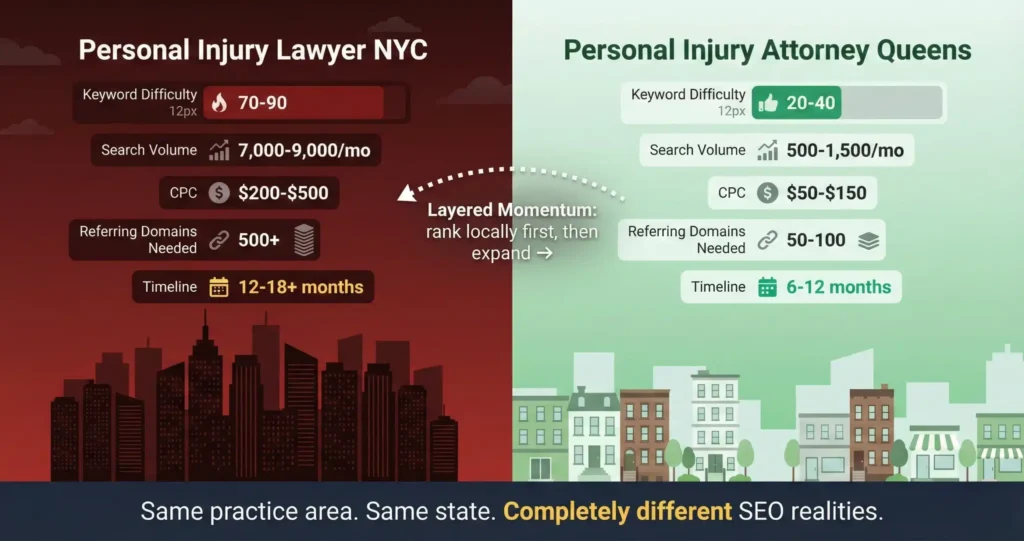
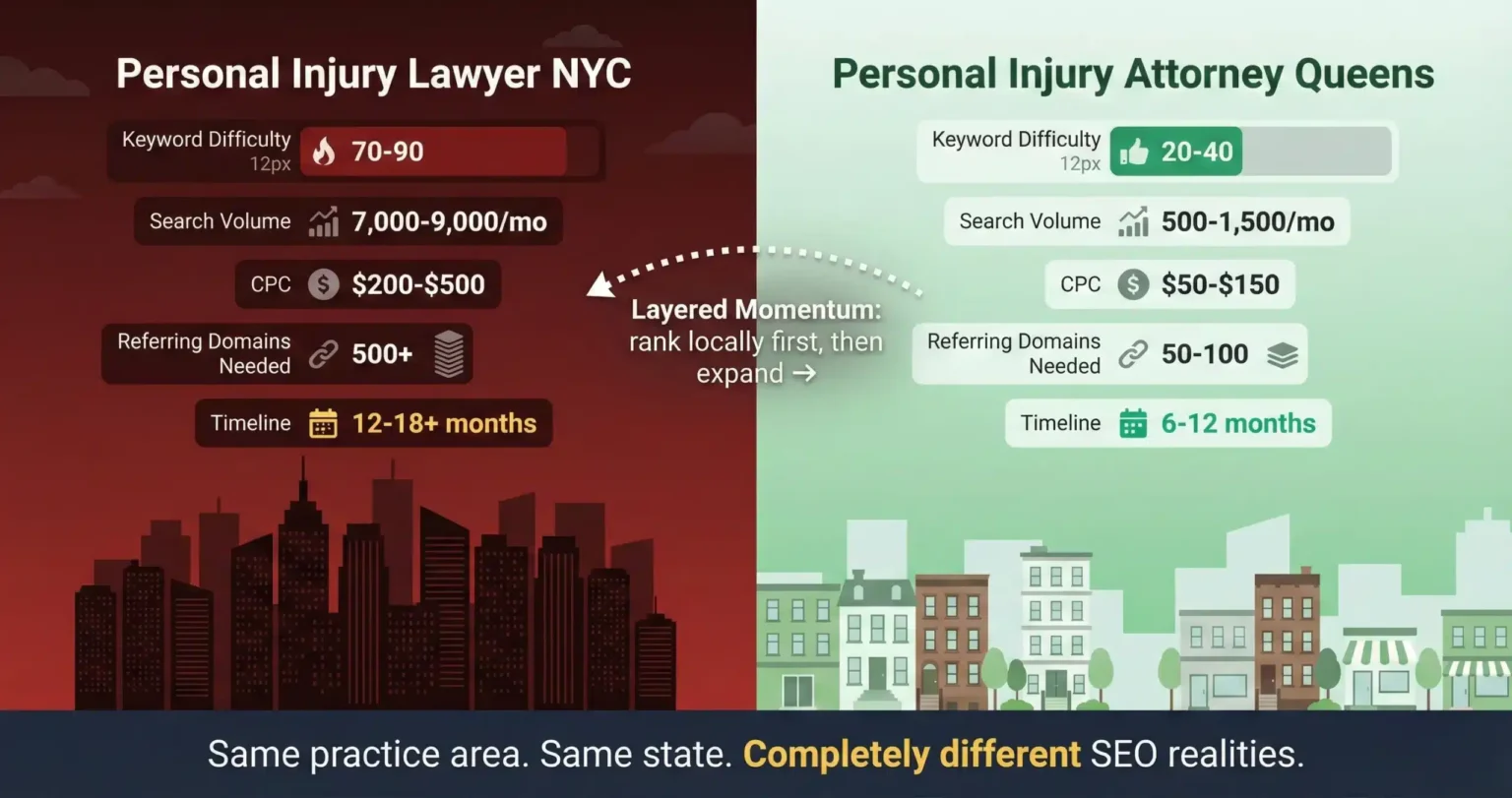
Metric PI Lawyer NYC (Manhattan) PI Attorney Queens Keyword Difficulty 70-90 / 100 (Very Hard) 20-40 / 100 (Moderate) Monthly Search Volume 7,000 – 9,000+ 500 – 1,500 Cost Per Click $200 – $500+ $50 – $150 Referring Domains Needed 500+ (high authority) 50-100 (local relevance) Primary Competitors National firms, mega-firms, directories Local boutiques, solo practitioners Timeline to Page 1 12 – 18+ months 6 – 12 months Manhattan is a “fat head” market with massive volume and massive competition from firms with $100K+ monthly marketing budgets and decade-long backlink histories. Queens is a fragmented market where Google treats each neighborhood as a distinct geographic entity, allowing firms to establish relevance through local signals (Google Business Profile proximity, local citations, neighborhood-specific content) faster than through raw domain authority. The strategy is to rank in Queens first and use that authority to fund and support the expansion into Manhattan-level terms.
“Personal injury lawyer NYC” and “personal injury attorney Queens” look like they’re in the same market but the keyword difficulty on the NYC term is somewhere between 70 and 90 out of 100 and the Queens term is between 20 and 40, and that gap means the NYC term needs 500 or more referring domains from high-authority sites while the Queens term needs maybe 50 to 100 from locally relevant sources, and one of those is a twelve to eighteen month project and the other is six to twelve months for the same practice area.
Manhattan is what you’d call a fat head market where you’re competing against firms that spend over $100,000 a month on marketing and have been building backlink profiles for a decade, and the only way in is either massive budget or massive patience or both, and a single query for “personal injury lawyer NYC” returns over eleven million results from competitors with domain ratings in the 50 to 70 range which for context is the kind of authority that takes years of sustained link building to achieve.
Queens works differently because Google treats it as a fragmented collection of neighborhoods rather than one market, so a firm in Forest Hills can rank for “Forest Hills personal injury lawyer” without needing to outmuscle the entire New York legal ecosystem, and the proximity signals from your Google Business Profile do most of the heavy lifting in the Map Pack which means you can generate calls from local residents within months rather than years, and that case flow funds the longer fight for the broader terms.
The Algorithm Has a Speed Limit on How Fast You Can Build Authority and There’s No Way Around It
What is the link velocity governor and how does it affect PI SEO timelines? Google monitors the rate at which a website acquires new backlinks (link velocity). If a new site suddenly acquires hundreds of high-authority links in a short period, it triggers spam filters that can result in penalties or the discounting of those links. This imposes a hard speed limit on how quickly a firm can close the “authority gap” with established competitors. Additionally, newly acquired links go through a “seasoning” period of 60-90 days before passing their full ranking equity. In a market like NYC where top PI firms have thousands of referring domains accumulated over 10-15 years, closing the gap requires either immense time or immense resources. A safe white-hat strategy acquires links at a natural gradual pace, meaning the full value of a six-month link building campaign might not be realized until months 9-12.
Even if you had unlimited budget you couldn’t just buy 500 backlinks in month one and rank by month two, because Google watches how fast your link profile grows and if a site that had 20 referring domains suddenly has 500 it doesn’t look like you earned those links through merit it looks like you bought them, and the algorithm either ignores the links entirely or penalizes the site which puts you further behind than where you started.
Links also go through what people in the industry call a seasoning period where a backlink you acquire today from a high-authority site doesn’t pass its full value for 60 to 90 days, which means the link building campaign you run in January doesn’t show up in your rankings until March or April at the earliest, and that delay stacks on top of the trust dampener delay and the content indexing delay and suddenly you understand why the twelve to eighteen month timeline isn’t the agency being lazy it’s the algorithm being cautious.
In a market like NYC where the top PI firms have thousands of referring domains built over ten or fifteen years, closing that gap isn’t something you do in six months even with aggressive spending, it’s a mathematical problem where the rate of acquisition has a ceiling imposed by the algorithm and the only variable you really control is whether you start now or start later and how much quality you can sustain at the maximum safe velocity.
Ranking Locally First and Then Expanding Is Not a Consolation Prize It’s the Only Strategy That Generates Revenue During the Wait
What is Layered Momentum and how does it accelerate PI SEO? Layered Momentum is an “outside-in” strategy that targets neighborhood and borough terms first before expanding to city-wide keywords. Phase 1 (Months 1-6): Rank for hyper-local terms like “Astoria car accident lawyer” or “Forest Hills slip and fall attorney” where keyword difficulty is low and local signals (GBP proximity, local citations) establish relevance quickly. Phase 2 (Months 6-12): Expand to borough-wide terms (“Queens personal injury attorney”) using authority accumulated from neighborhood pages. Phase 3 (Months 12-24): Target city-wide “NYC” terms only after establishing a ring of local authority across multiple neighborhoods. This strategy generates case flow in months rather than years, funding the continued investment in broader terms. Multilingual content in markets like Queens (56% of residents speak a language other than English) provides an additional acceleration path since competition for Spanish and Chinese PI terms is significantly lower than English equivalents.
Ranking for “personal injury lawyer NYC” as your first target is like trying to take Manhattan by landing troops directly on Midtown, and the smarter approach is what some agencies call Layered Momentum where you start with the neighborhoods and work inward, ranking for “Harlem personal injury lawyer” or “Astoria car accident attorney” first where the competition is a fraction of what the city-wide terms demand and the local signals from your Google Business Profile can carry most of the weight.
Phase one is months one through six and it’s all hyper-local, building neighborhood-specific pages for every area where you have a physical presence or community connection, and those pages can rank in months rather than years because Google doesn’t need you to be the best firm in New York it just needs you to be the most relevant firm in that specific neighborhood, and every consultation that comes in from “Forest Hills slip and fall” or “Jamaica car accident” is a case that funds the next phase of the strategy.
Phase two expands to borough-wide terms once the neighborhood pages have accumulated enough authority and internal linking equity to support broader rankings, and phase three is the city siege where you go after the “NYC” terms with a site that already ranks in a dozen neighborhoods and has the traffic history and backlink profile to compete with the incumbents, and the whole approach takes eighteen to twenty-four months to complete but it generates revenue starting around month four or five instead of making you wait a year and a half for the first organic call.
One thing that almost nobody talks about in the NYC market is that Queens is the most linguistically diverse place on earth and 56 percent of residents speak a language other than English at home, and ranking for “abogado de accidentes” or Chinese-language PI terms has dramatically lower competition than the English equivalents, which means a firm can dominate the Spanish-speaking PI market in Queens in six months while still grinding through page three for the English terms, and that bilingual revenue stream makes the whole timeline survivable.
Want to know how long your specific market will take?
Send me your practice area, your target geography, and your top three competitors and I’ll map the keyword difficulty, the authority gap, and the realistic timeline for your specific market, including where the local entry points are and how to generate cases during the build-up phase.