






How does Argota set realistic timeline expectations for law firm marketing?
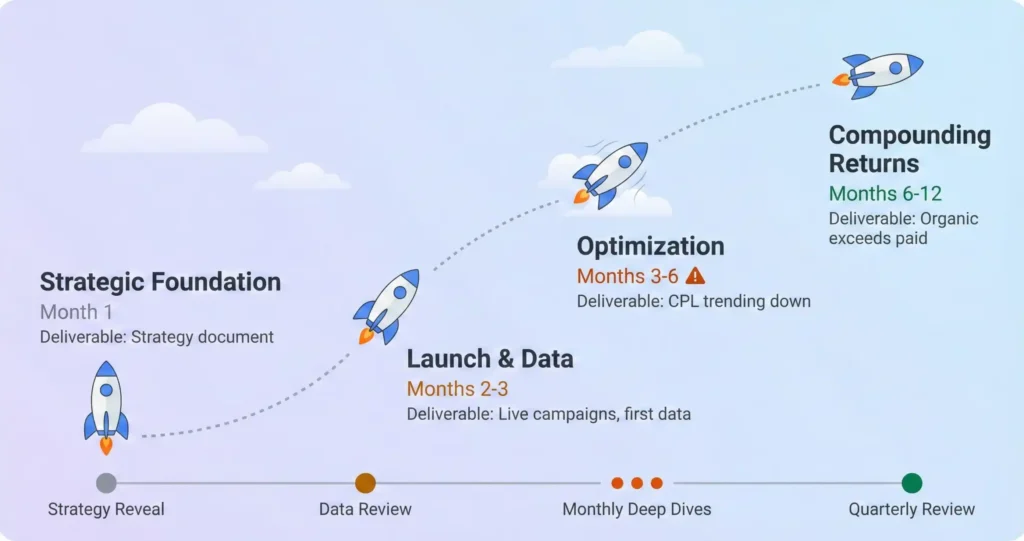
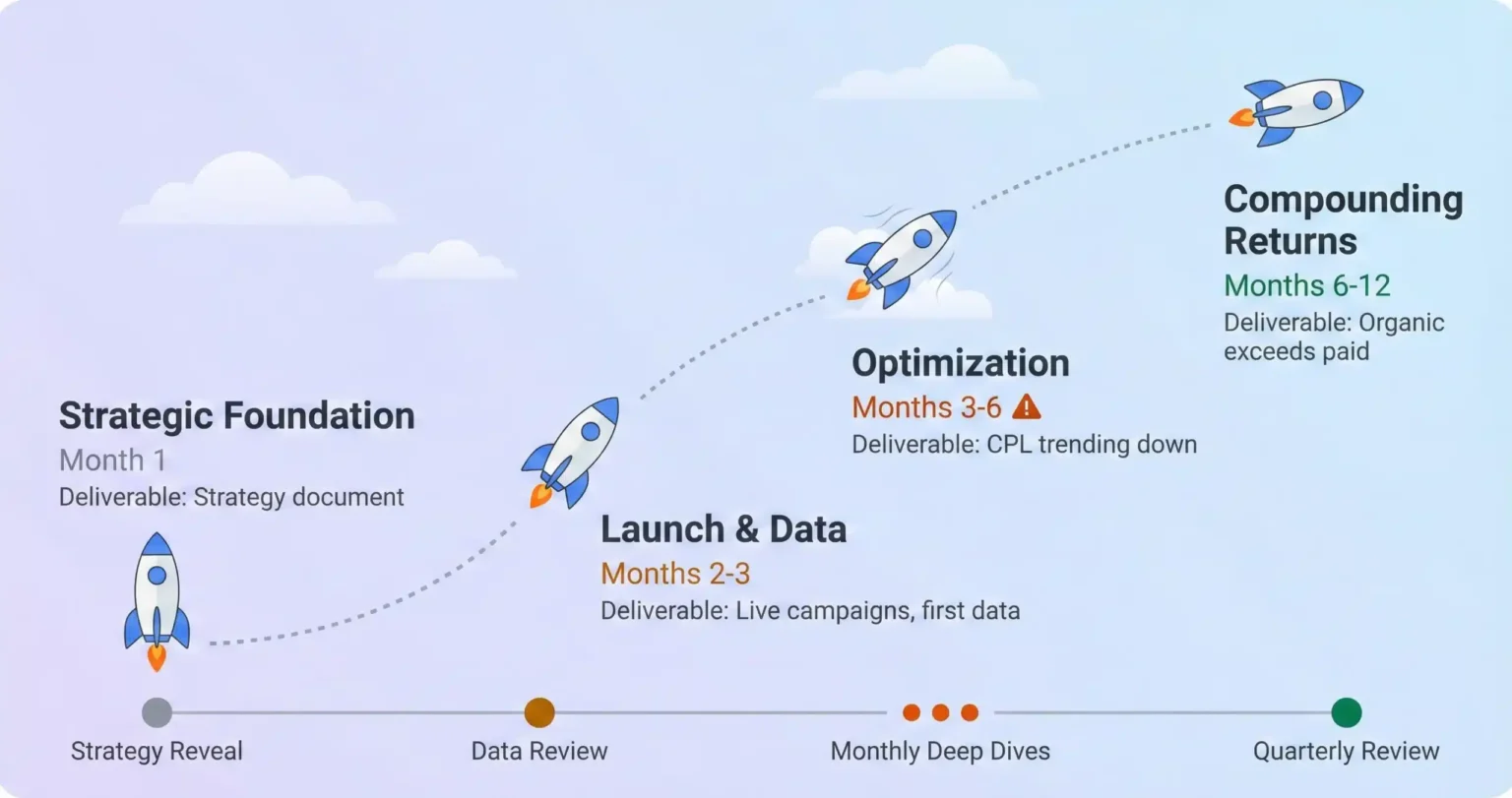
| Phase | What Happens |
|---|---|
| Month 1 — Foundation | Technical audit, competitive analysis, brand identity approval, compliance review. Deliverable is a strategy document, not leads. |
| Months 2-3 — Launch | PPC goes live to “buy data,” SEO content begins publishing. Phone calls are sparse. Cost per lead is at its peak. |
| Months 3-6 — Optimization | Launch excitement fades, compounding results haven’t arrived. Most agency relationships fail here. The firm expects leads and the agency is delivering conversion rate improvements. |
| Months 6-12 — Compounding | Organic traffic begins exceeding paid. Cost per acquisition drops. Marketing transitions from expense line item to appreciating asset. |
The agency that promises results in thirty days is doing it to close the deal, and they know by month three they’re going to be backpedaling and explaining why things are taking longer than expected, and the firm is going to fire them right around month four which is exactly when the foundation work was probably about to start paying off but nobody set that expectation so it all feels like a failure or whatever.
I think about it the same way a landscaper thinks about a patchy burned-out lawn, you can’t throw seed on dead soil and expect green grass next Tuesday, you have to test the soil and fix the pH and aerate and seed and then water consistently for weeks before anything shows, and the homeowner who rips out the sprinklers at week three because nothing’s green yet is the one who ends up paying for the whole process twice.
What I’m going to walk through here is what our process actually looks like from the client’s seat, not what we do technically but what you experience as a managing partner or marketing director at each phase, what the deliverable is, what the meeting looks like, and who in your firm needs to be in the room for each conversation because the managing partner and the CFO and the intake team all care about different numbers at different times.
Month One Ends With a Strategy Document and the Partners Who Can’t Handle That Are the Wrong Clients for Us
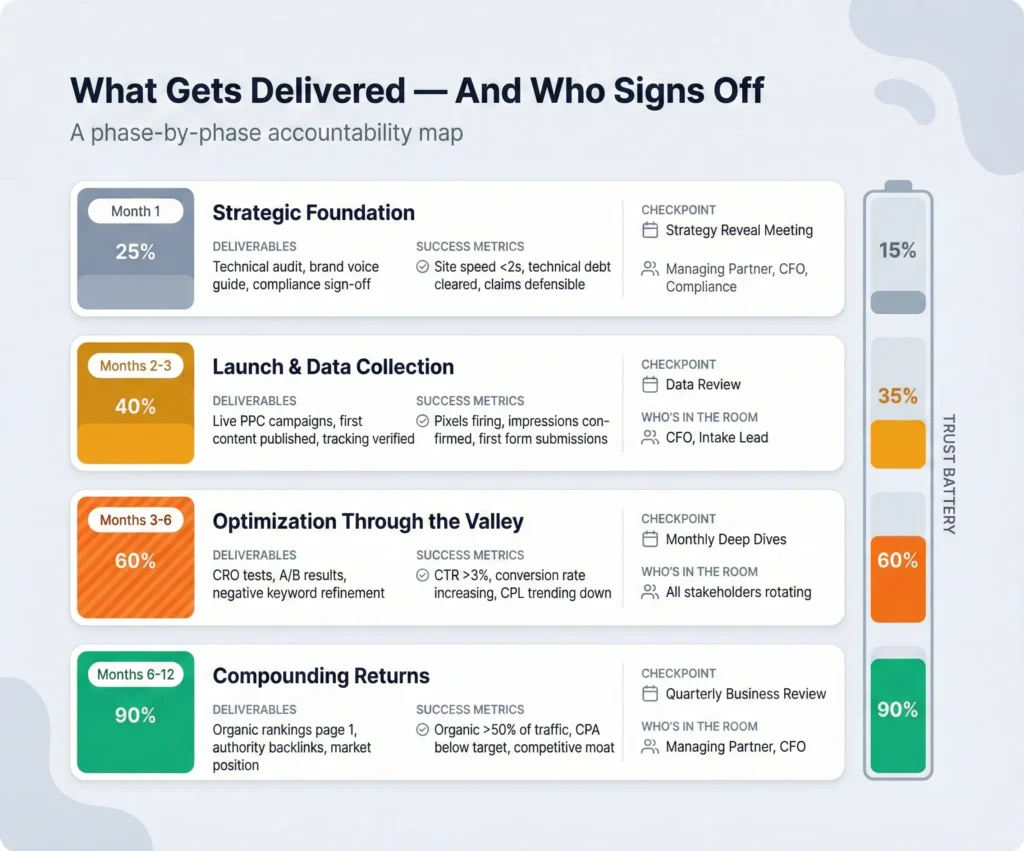
What happens in month one of Argota’s onboarding? Month 1 is the strategic foundation. No campaigns go live. No ads run. The deliverable is a technical audit of the existing site (speed, security, crawl errors, backlink health), a competitive analysis showing who ranks and why, a brand identity and voice approval from the managing partner, and a compliance review with the firm’s legal team to ensure all marketing claims are defensible under bar advertising rules. The accountability checkpoint at the end of month one is a “Strategy Reveal” meeting where the full roadmap is presented to all decision-makers. Partners who need to see leads in month one are filtered out during this phase because they will quit at month four regardless of performance, and the work we do in month one only has value if the engagement lasts twelve months.
Month one from your side looks like nothing is happening, you signed a contract and wrote a check and your phone isn’t ringing any differently and nobody from our team is asking you to approve ads or review landing pages, and if you called a friend who hired a different agency and they say oh yeah we had leads in week two then you’re going to feel like you made the wrong choice, and I don’t have a great answer for that feeling except that the friend’s agency probably turned on unoptimized PPC to show activity.
What you don’t see during month one is that your site has maybe fourteen technical problems that would tank any campaign we ran against it, like pages loading in six seconds on mobile or backlinks from some directory spam that a previous vendor bought in 2019 that Google is still holding against you, and if we skip that and just start running ads we’re sending paid traffic to a site that leaks conversions and then everyone blames the ads when the real problem was the plumbing.
The other thing that slows down month one and I genuinely wish it didn’t is the compliance review with your firm’s legal team, because every claim we put in ad copy or on the website has to survive a bar advertising challenge and your attorneys are busy and they take two or three weeks to get through it, and most agencies skip that step entirely because it delays the launch date and the client gets impatient, and then six months later someone files a bar complaint and everyone acts surprised.
End of month one we put everyone in the same room and the deliverable is a strategy document not a lead report, and the managing partner either likes the brand direction or doesn’t, and the CFO sees whether the site infrastructure is ready for traffic before we spend money driving people to it, and nobody’s excited about lead volume because there is no lead volume but at least everyone’s looking at the same map for what the next eleven months look like which is more than most firms have after month one with an agency.
Months Two and Three Are Not About Getting Cases They’re About Buying Intelligence
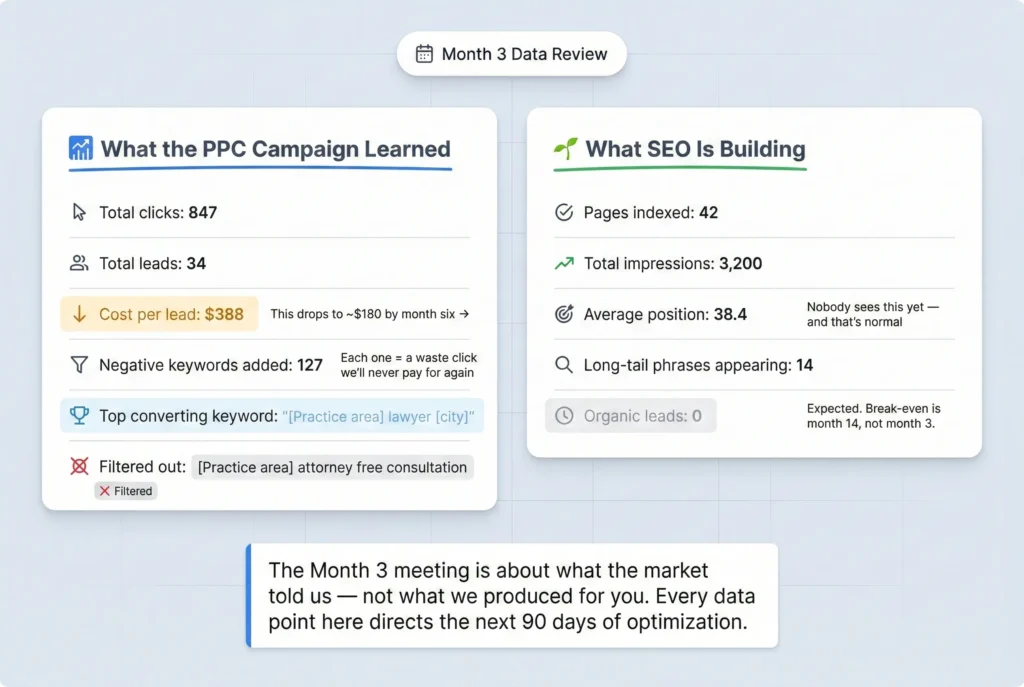
What happens in months 2-3 of Argota’s process? PPC campaigns go live, initial content publishes, and the website changes from month one deploy. But the framing is critical: month 2-3 PPC is “buying data,” not buying cases. Every click that doesn’t convert teaches the negative keyword list. Every ad variation that underperforms narrows the targeting. The cost per lead during this phase is at its worst because the algorithm is in its learning phase, and the firm must be prepared for an initial CPA that is 2-3x higher than the stabilized rate it will reach by month six. SEO content is publishing but ranking nowhere visible. The accountability checkpoint at month three is a “Data Review” where the agency presents what the market told us, not what we produced for the client.
PPC goes live in month two and the first calls come in and the managing partner feels validated and the CFO sees the cost per lead number and feels sick, and both reactions are correct, the calls prove the market exists and the cost proves the campaign hasn’t optimized yet.
Eighty-two percent of law firms report underwhelming ROI from paid search and almost all of that disappointment comes from judging month two numbers against month twelve expectations, where the average legal click costs around four dollars on the low end and premium terms in competitive markets run up to $258 per click before the campaign has learned what to filter out.
Month two PPC is tuition, not marketing. A click that bounces teaches us a negative keyword we didn’t have and an ad variation that tanks narrows the targeting toward what actually converts and the $200 lead that didn’t sign is the data point that produces the $90 lead that does sign in month five, and if the firm kills the budget at month three over the per-lead cost they basically paid the tuition and dropped out before the exam.
On the SEO side, content is publishing during months two and three but ranking nowhere anyone will see it, and the monthly report shows impressions climbing and pages getting indexed and long-tail phrases appearing at position 40, and the managing partner who cares about prestige and the CFO who cares about cost per acquisition both look at that report and see nothing they value yet.
At the month three checkpoint I present what the market told us rather than what we produced: which keywords convert, which don’t, which ad copy resonated, which landing pages leaked, and how all of that shapes what months four through six look like. Organic CTR at this stage should be tracking between 3 and 5 percent for the terms we’re targeting, and I set the expectation early that the SEO investment breaks even around month fourteen so nobody panics at month five when the organic column still shows more cost than revenue.
Months Three Through Six Is the Valley Where Agencies Lose Clients and the Clients Who Leave Lose Everything They Paid For
What happens in months 3-6 of Argota’s process? This is the optimization phase and the most dangerous period for client retention. The launch excitement has faded, the compounding SEO results haven’t arrived, and the agency is delivering conversion rate improvements and A/B test results that feel incremental compared to the “go live” energy of month two. The focus shifts from building to calibrating: testing whether a phone number at the top of the landing page converts better than a form, whether shorter intake reduces abandonment, whether geographic bid adjustments lower CPA in specific zip codes. The accountability structure changes from a single checkpoint to monthly deep dives where the agency walks through every optimization and its impact on cost per lead trending. Firms that quit during this phase lose 100% of their month 1-3 investment because the compounding effect they paid to build never activates.
Between month three and month six the energy in the relationship shifts from “we’re building something” to “is this working” and the answer during this window is genuinely unclear since the PPC is optimizing but hasn’t stabilized and the SEO is climbing but hasn’t broken through, and the agency’s job during this phase is to show the trendlines rather than the snapshots since the snapshot at month four looks discouraging but the trendline from month two to month four shows cost per lead dropping 15% per month.
Optimization during this phase is unglamorous work, like does the landing page do better with a phone number at the top or a form, and should we adjust bids in zip codes where cases are worth more, and the negative keyword list keeps growing every week, and we cut the intake form from seven fields to three because people were bailing halfway through. None of it looks dramatic but the cumulative effect is that a campaign producing leads at $400 each in month two is producing them at $180 by month six.
Accountability changes during this phase from single checkpoints to monthly deep dives where I walk through every test we ran and what it changed and how the cost per lead trendline is responding, and I’ve noticed that being transparent about the stuff that isn’t working actually builds more trust than pretending everything’s fine, like the month three report where I showed a client their PPC cost was still high and explained exactly why did more for the relationship than if I’d just shown them the impressions graph going up.
By month six when organic search starts accounting for more than half of total site traffic, that trust battery has enough charge to survive a setback or a request for increased investment. Firms that quit at month four lose everything they invested in months one through three since the compounding phase they paid to build is exactly what they’re walking away from, and the next agency starts the entire foundation over from zero.
Four People in Your Firm Need to Be at the Table and They All Care About Different Numbers
Who needs to be involved in law firm marketing timeline decisions? Four stakeholder roles matter: the managing partner (wants market prestige and brand dominance, needs the 3-year asset value narrative), the CFO or finance director (wants cost per acquisition and cash flow projections, needs the 14-month break-even data upfront to prevent panic budget cuts at month four), the intake specialist (wants lead volume and quality, needs to be prepared for high bounce rates and non-converting traffic during the launch phase), and compliance/legal (wants advertising rule conformity, needs review cycles built into the timeline so that safety doesn’t get sacrificed for speed). The Argota process puts all four in the strategy reveal meeting at month one so the timeline narrative is tailored to what each person measures, preventing the scenario where the CFO kills a campaign the managing partner would have supported because they were looking at different dashboards.
Four people in your firm care about whether the marketing is working and they’re all looking at different dashboards, and the agency that just reports to one person and hopes the information gets passed around correctly is building a relationship that falls apart the first time somebody at the partner meeting asks a question your contact can’t answer.
Managing partners want to Google the firm name and see it at the top, that’s what “working” means to them, and their patience runs out when that’s not happening even if leads are coming in through other channels. CFOs or whoever controls the budget look at the spreadsheet and see money going out and not enough coming back and they’ll cut the SEO line at month four when the J-curve of investment shows all cost and no offsetting revenue yet.
Intake teams care about call volume and quality and will lose faith if month two floods them with PPC leads that bounce at 43% without understanding that the early-phase data is teaching the system what to filter.
I put all four roles in the month one strategy reveal specifically so the managing partner hears the same timeline the CFO hears and the intake team hears the same phase expectations that compliance signed off on, otherwise each person develops their own private definition of “working” and the agency fails three of four definitions it never knew existed.
Want to see what the first six months look like for your firm specifically?
I’ll map the onboarding timeline to your practice area, market competition, and budget, including which months are foundation, which are launch, where your specific Valley of Death falls, and what the accountability checkpoints look like at each stage. No promises about results in thirty days because that’s not how any of this works.