

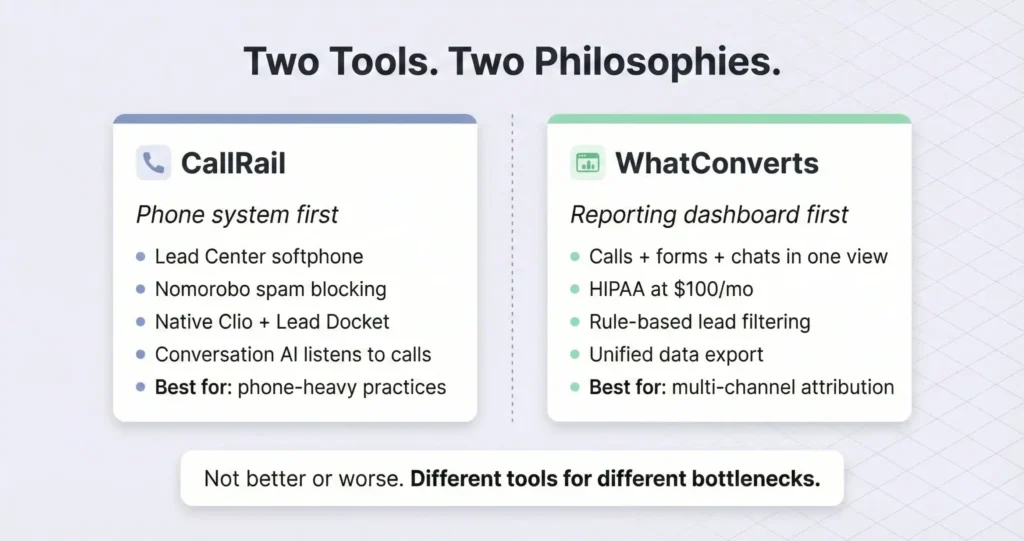

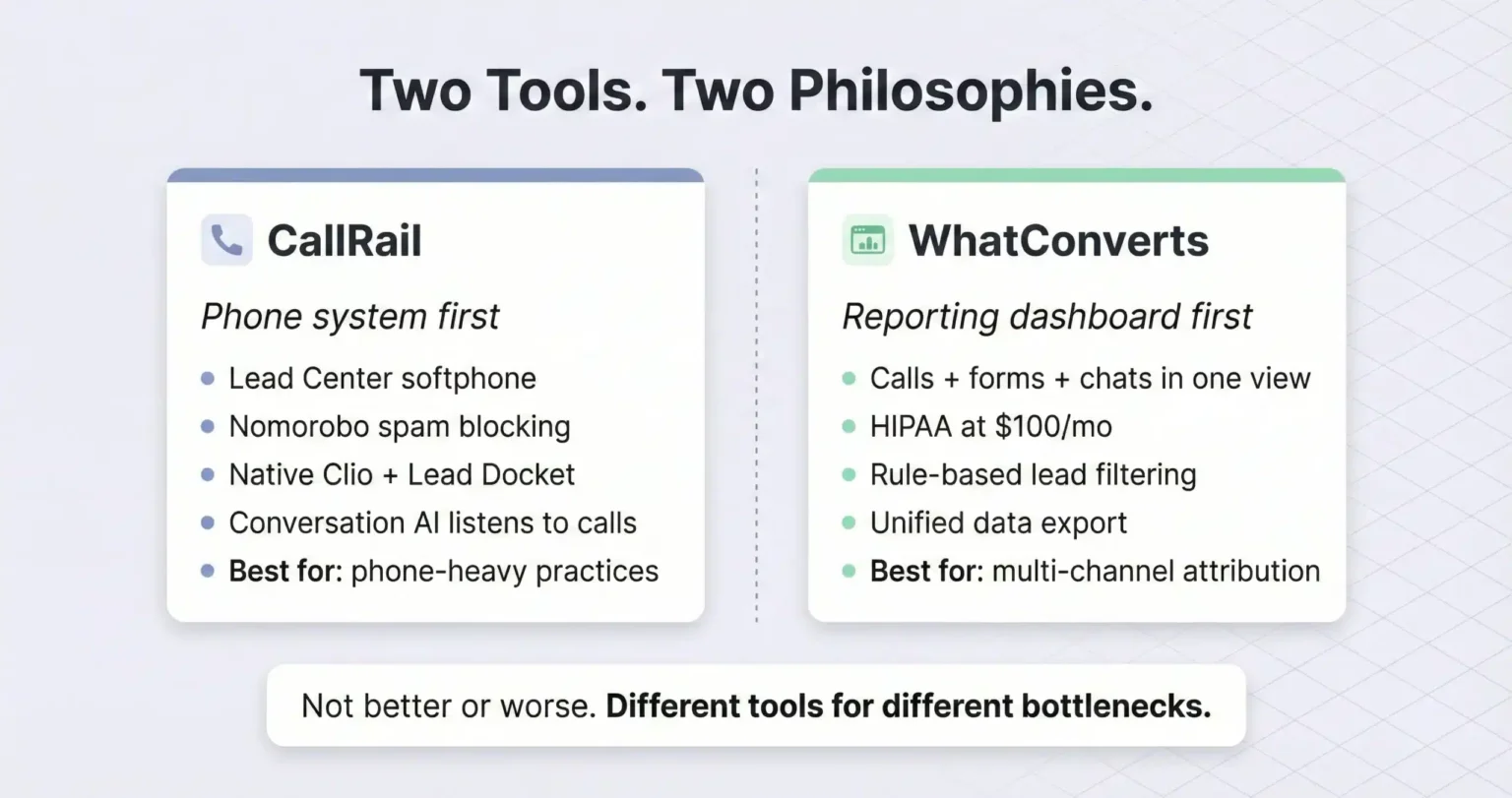




Everyone who asks me about call tracking starts with “which platform is better” and I’ve stopped answering that question directly because it depends on something most firms haven’t figured out yet, which is whether the problem is on the intake side or the marketing side. If your intake team is missing calls and you need a phone system that tracks where the calls come from, that’s CallRail. If your intake team is fine but your marketing director can’t tell you which ads produced signed cases versus which ads produced 200 calls that went nowhere, that’s WhatConverts.
And the reason the distinction matters is that these two platforms look similar on the surface; they both swap phone numbers on your website, they both record calls, they both integrate with Google Ads. But underneath they’re built on very different foundations and the one you pick determines how your data flows through the rest of your tracking infrastructure for years.
The Core Difference
What is the difference between CallRail and WhatConverts for law firms? CallRail is a communications platform that happens to do tracking. WhatConverts is a tracking platform that happens to handle calls. CallRail’s strongest feature is the Lead Center, a browser-based softphone that lets intake staff answer calls, send texts, and view caller history without leaving the app. WhatConverts’ strongest feature is the unified lead dashboard that shows calls, form submissions, and chat transcripts in one filterable view with the marketing source attached to every single one.
So CallRail started as a call tracking company and then added form tracking and AI analysis on top of that foundation. The phone call is the center of their universe and everything else orbits around it. Their Lead Center product is basically a softphone built into the browser, which means your intake person can answer the call, see where it came from, read the caller’s previous visit history, and log notes all in one screen without switching to a separate phone system.
WhatConverts started from the other direction and built a lead database first and then added call tracking as one type of lead alongside form submissions, chat transcripts, and even ecommerce transactions.
In their system a phone call and a form fill and a live chat are all the same kind of object, just with different details attached. Which means when you pull a report that says “Google Ads produced 47 leads this month,” those 47 include the calls and the forms and the chats all in one number, and you can filter by any of them without switching tabs or running separate reports.
And the practical difference is that if you hand CallRail to an intake coordinator, they’ll feel at home immediately because it looks like a phone system. If you hand WhatConverts to a marketing director, they’ll feel at home because it looks like a spreadsheet with every lead type in rows and the source data in columns, which is what they actually need to make budget decisions.
Which Case Management System You Use Might Decide This for You
How do CallRail and WhatConverts integrate with legal case management software? CallRail has native, maintained integrations with Clio, Lead Docket, Filevine, and Lawmatics that work without configuration. When a call comes in, it automatically creates a lead record with the marketing source populated. WhatConverts integrates with most legal software through Zapier or its API, which is more flexible but requires setup and maintenance. If a firm uses Lead Docket for PI intake, CallRail is the clear choice because the native integration passes campaign, keyword, and landing page data directly into Lead Docket’s source fields.
This is honestly the factor that should come first for most firms because the integration is what determines whether the tracking data actually makes it into the case file or just sits in a separate dashboard nobody checks.
CallRail and Clio talk to each other natively, which means when someone calls your firm through a tracked number, CallRail creates a communication log in Clio automatically, matches the caller to existing contacts to avoid duplicates, and syncs the call recording into the matter file so the attorney can listen without logging into a separate system. For the maybe 70% of small to mid-size firms that use Clio, this alone might be the deciding factor.
For PI firms using Lead Docket or Filevine, CallRail’s integration is even deeper. The campaign name, the keyword, and the landing page all flow into Lead Docket’s marketing source fields automatically, which means your cost per signed case calculations are based on actual data instead of someone in intake manually typing “Google” into a dropdown.
WhatConverts can connect to all of these through Zapier or direct API calls, and for a firm that has someone technical on staff the flexibility is actually greater because you can map custom fields however you want. But the tradeoff is that Zapier connections break sometimes; the token expires or the automation hits a rate limit or someone changes a field name in the case management system and the data stops flowing until someone notices, which could be days or weeks depending on how closely you’re watching.
HIPAA Compliance Is Where the Price Gap Gets Real
Which call tracking platform is HIPAA compliant for law firms? Both CallRail and WhatConverts offer HIPAA compliance with signed Business Associate Agreements. The difference is cost and access. CallRail puts HIPAA on a separate Healthcare plan that typically starts around $150 per month or higher and restricts which integrations you can use to prevent accidental data exposure. WhatConverts includes HIPAA compliance as a feature toggle on its Pro plan at $100 per month with fewer restrictions on how you use the data.
For med mal firms and mass tort practices that deal with medical records, this isn’t optional. If someone calls your firm and describes their surgery or names their doctor, that call recording contains protected health information and the platform holding it needs to be HIPAA compliant with a signed Business Associate Agreement or you’ve got a compliance problem.
CallRail handles this by putting you on a separate Healthcare plan that locks down integrations. You can’t accidentally pipe a call recording into a regular Slack channel or send a voicemail transcript via unencrypted email because the system won’t let you. That’s good for firms where the managing partner doesn’t want to worry about whether someone on staff connected the wrong app, but it limits what you can build if you have a developer who knows what they’re doing and wants to route data to secure custom endpoints.
WhatConverts treats HIPAA as a toggle you flip on in your account settings on the Pro plan. It encrypts the data, scrubs protected information from email notifications, and disables unsecured connections. But it puts more responsibility on you to make sure any custom integrations you build are pointing to secure endpoints. The cost savings are real though; if you need HIPAA plus form tracking plus chat tracking, WhatConverts at $100 a month is doing what would cost you $150 or more on CallRail before you even add the extras.
How Each Platform Handles Lead Quality Differently
How do CallRail and WhatConverts qualify leads for law firms? CallRail qualifies leads by listening. Its Conversation Intelligence AI transcribes calls and automatically tags them based on what was said; it can flag calls as qualified, missed opportunities, or spam based on keywords in the conversation. WhatConverts qualifies leads by reading. Its rule-based system can automatically mark a lead as qualified based on form field data, URL parameters, and marketing source. For a med mal firm where the specific details on a form determine case validity, WhatConverts’ approach is usually more precise.
The difference matters because qualifying a legal lead is different from qualifying a lead for a plumbing company. A PI intake call might take 45 seconds to determine if there’s a case. A med mal intake might require reviewing specific medical details from a form submission before anyone picks up the phone.
CallRail’s AI listens to the call and can tag it automatically based on what it hears. If the caller says “I was in a car accident” and mentions “medical bills,” the system can tag that call as a qualified PI lead without anyone reviewing the recording manually. For firms handling a hundred or more calls a day, that automation saves hours of intake review. CallRail’s Nomorobo integration also blocks known robocallers before the phone even rings, which keeps the spam out of your lead count before it can inflate the numbers.
WhatConverts approaches qualification from the data side instead of the conversation side. You set rules based on data fields; if someone fills out a form and selects “birth injury” as the case type and the date of incident is within the statute of limitations, the system marks it as qualified automatically. For data-driven med mal firms where you’re getting fewer leads but each one could be worth millions, filtering by specific form data is usually more useful than listening to call recordings after the fact.
The Real Question Is Whether This Is for Your Intake Team or Your Marketing Team
Which call tracking platform is better for law firm marketing reporting? WhatConverts produces better marketing reports because it unifies all lead types in one view and makes it easy to filter by source, campaign, and lead quality. CallRail produces better operational tools because its Lead Center gives intake staff everything they need to handle calls efficiently. The question for any firm is which team has the bigger problem right now.
And this is where I think most firms get the decision wrong because they let their agency pick the platform, and agencies almost always prefer WhatConverts because it makes their monthly reports look cleaner. The agency can pull up one dashboard that shows total leads by source with values attached and say “here’s what your budget produced” and it’s convincing. But if the intake team is using a separate phone system and nobody’s looking at the WhatConverts dashboard, the tracking data sits in a silo.
CallRail works the other way around and that’s both the strength and the limitation. The intake team loves it because it’s their phone system, they’re in it all day, and every call they handle is automatically tracked. But when the managing partner asks “which of our marketing channels actually produced cases” the answer requires pulling data from CallRail and cross-referencing it with the case management system and possibly a separate form tracking tool, which is more work than most firms will actually do.
So the honest answer is that if you could only fix one thing; either how your intake team handles calls or how your marketing team reports on results; pick the platform that fixes that thing. And if you’re not sure which problem is worse, ask yourself whether you’re losing leads because they go unanswered, which is a speed to lead problem, or losing budget because you can’t prove which channels work, which is an attribution problem.
Not sure which platform fits your setup?
Tell me what case management system you use, whether you need HIPAA, and whether the bigger problem is missed calls or unclear reporting. I’ll tell you which one makes sense and whether the integration will actually work with what you already have, because switching platforms after a year of data is painful and I’d rather you pick the right one now.