

Written by Jorge Argota · Legal Marketing · United States
So I’ve been saying for years that the firms spending more on marketing are the ones growing and the firms spending less are the ones that are flat, and everyone nods but nobody really believes it because it sounds like the marketing guy telling you to spend more money. But then Hinge Research published their annual study and the numbers were honestly more extreme than even I expected; high growth firms are spending 16.5% to 26.9% of gross revenue on marketing while the stagnant firms are at about 5%. And the part that should make every managing partner sit up straight is that the firms spending three times more are also running 40% profit margins, which is the opposite of what you’d expect if you think of marketing as a cost instead of an investment.
TL;DR
The Hinge Research Institute studied hundreds of professional services firms and found that high growth firms spend 16.5% to 26.9% of revenue on marketing versus 5% for stagnant firms. They invest 3.3 times more, grow 4 times faster, and still run 40% profit margins because the marketing changes what kind of cases walk in, how fast they close, and how much fixed cost gets spread across the caseload. This page is about why. The budget guide has the exact dollar ranges by firm size and practice area.
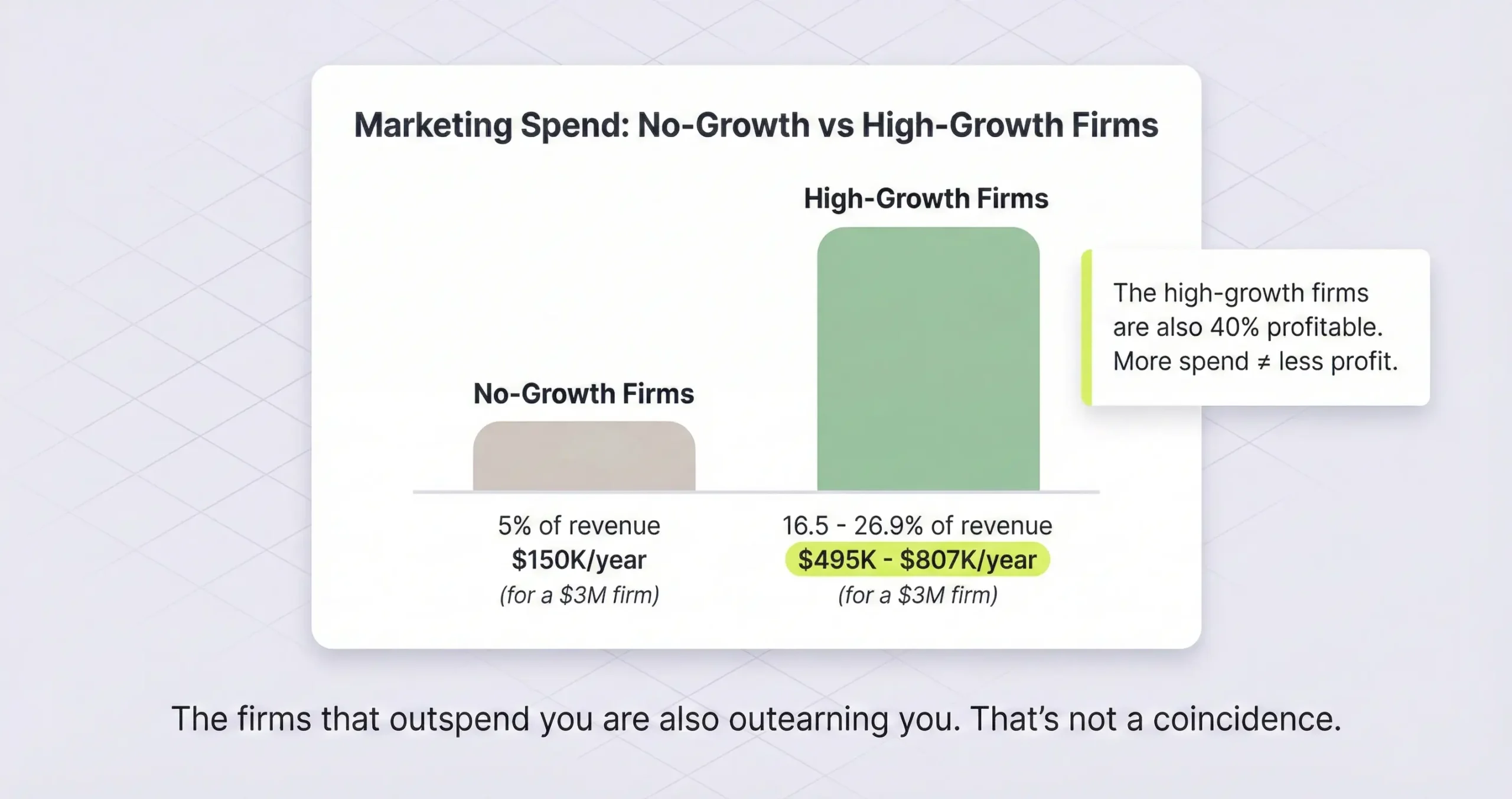
So Hinge Research did this study where they split law firms into two groups; firms that were growing and firms that were stagnant or declining. And when they compared the marketing budgets the difference wasn’t small. The firms that weren’t growing were spending about 5% of gross revenue on marketing, which is basically enough to keep the website running and renew some directory listings and not much else. The firms that were growing fastest were spending 16.5% to 26.9% of revenue, which on a $3 million firm is somewhere between $495,000 and $807,000 a year.
5%
No-growth firms spend on marketing
16.5%
High-growth firms spend on marketing
~40%
Profit margins at high-growth firms
And the part that broke my assumption about marketing budgets is that the firms spending more weren’t less profitable; they were averaging around 40% profit margins. I spent a long time thinking of marketing as a cost you minimize and it turns out the data says the opposite, at least for the firms doing it right.
I wrote a broader piece on law firm marketing budgets by firm size that covers dollar ranges from solo to large firm, channel allocation splits, and cost per lead benchmarks by practice area. This post is about what those high-growth firms are actually doing with the money and why spending three times more produces better margins instead of worse, which I still think is the most counterintuitive thing in legal marketing.
WHY SPENDING MORE PRODUCES BETTER MARGINS INSTEAD OF WORSE
How can law firms spend 25% on marketing and still be 40% profitable? I asked this question for a long time because the math didn’t seem to add up. And the answer is three things happening at once that most people only think about individually.
When a firm invests in content that positions its attorneys as recognized authorities, potential clients trust them before the first call, shop around less, and accept higher fees. The marketing also attracts better-fit cases that generate more revenue per hour worked. And the volume of cases from consistent marketing spreads fixed costs like rent, staff, and software across more revenue. Those three effects combined mean higher spending creates better economics, not worse.
So the thing I couldn’t figure out for a while is why spending 25% on marketing doesn’t just eat the profit. And the answer is that the marketing changes what kind of cases walk through the door and how those cases close.
The Visible Expert effect: When someone finds your firm through an article you wrote about trucking accident liability and they’ve read maybe three of your posts before they pick up the phone, that’s a different conversation than when someone found you on page two of Google and they’re calling six other firms at the same time. The first person already trusts you, they’re less sensitive to fees, and they close faster. Hinge calls this the “Visible Expert” effect and their data shows those attorneys are about 2.5 times more likely to be trusted by potential clients before the first meeting even happens, which means higher close rates and higher fees per case.
And then there’s the volume piece which is maybe simpler but just as important. A firm spending 5% has low case volume which means the rent and the staff salaries and the software subscriptions eat a bigger percentage of every dollar that comes in. A firm spending 20% has enough cases coming in that those same fixed costs get spread across way more revenue, and that’s what creates the margin even after the marketing cost per signed case is accounted for.
WHO ACTUALLY NEEDS TO SPEND 16 TO 27% AND WHO DOESN’T
So this isn’t a universal number and I want to be honest about that. If you’re an established estate planning firm with a referral network that keeps the lights on and you’re not trying to double revenue, 5 to 8% is probably the right range and spending 20% would be a waste of money.
But there are three situations where the 16 to 27% range is the operating reality. The first is market entry; you open a new office and you think the marketing cost will be similar to your main office but it’s not because in the main office you have years of organic rankings and reviews and brand recognition and in the new market you have none of that. So the acquisition cost runs higher for the first 12 to 18 months while you build all that from scratch.
The second is PI and criminal defense in saturated metros where a single click on “truck accident lawyer” costs $200 or more and you need consistent volume to feed the staff. And the third is any firm that’s made the decision to grow aggressively over two or three years, where you’re basically reinvesting every dollar of free cash flow into buying market share before competitors figure out what you’re doing.
HOW THEY KEEP THE COST PER CASE FROM GETTING OUT OF CONTROL
So the firms that spend at this level and still stay profitable are doing something specific with the mix; they’re blending cheap lead sources with expensive ones on purpose. A slip and fall case from SEO content might cost $400 to sign. A catastrophic trucking case from paid search might cost $5,000 to sign. Running both at the same time means the blended cost per signed case across the caseload stays profitable even though individual channels vary widely. The budget guide has the full cost per lead and cost per signed case tables broken out by practice area and channel.
So the firms that do this well are mixing those together on purpose. They run SEO and educational content to produce the cheaper leads because organic traffic doesn’t cost anything per visitor once the content ranks, and the people finding you through articles are partly pre-qualified before they call. And they run paid search on the expensive keywords to catch the high-intent catastrophic cases where the case value justifies the acquisition cost.
The 95% that most firms ignore: About 95% of people searching for legal information aren’t ready to hire today and they’re just researching. If you only target the 5% ready to buy, you’re competing in the most expensive space against every other firm. If you capture some of that 95% with content and then retarget them later when they are ready, you’ve added a lead source that costs a fraction of what bottom-of-funnel paid search costs, which is how the blended number stays profitable even at 25% spend.
WHAT THE RETURNS ACTUALLY LOOK LIKE
And the returns on this kind of spending aren’t proportional to the spend in a straight line, which is the part that I think most budget conversations miss. Spending $5,000 a month in a competitive PI market is what I’d call below the noise floor, meaning you’re spending money but you’re not spending enough to actually show up where people are looking, so the money produces basically nothing and you conclude that marketing doesn’t work.
The noise floor problem: A firm spending $30,000 a month in a competitive market might be in the top three positions on Google and capturing maybe 60% of the leads that the $5,000 firm can’t even see. And the difference between those two isn’t just six times the leads; it’s the difference between being in the auction at all and being invisible, which is why doubling the budget doesn’t just double the results, it can produce four times the growth according to the Hinge data.
And only about 18% of firms are tracking this properly with multi-touch attribution that connects the ad click to the signed case. The other 82% are making budget decisions based on partial data, which is part of why so many firms think paid search isn’t worth it when the real problem is they can’t see what the channel is actually producing and they’re spending below the threshold where it would produce anything anyway.
Want to see where your firm falls on the growth curve?
Send me your current revenue and marketing spend and I’ll benchmark it against the Hinge data and tell you whether you’re in the maintenance zone, the growth zone, or below the noise floor. And if you’re already spending at the right level and not seeing the returns, the problem is somewhere else and I’ll tell you where to look.
Related: Law Firm Marketing Budget by Firm Size · What Good ROI Looks Like · Complete 2026 Strategy Guide · Predictable PI Pipeline · Cross-Channel Synergy