

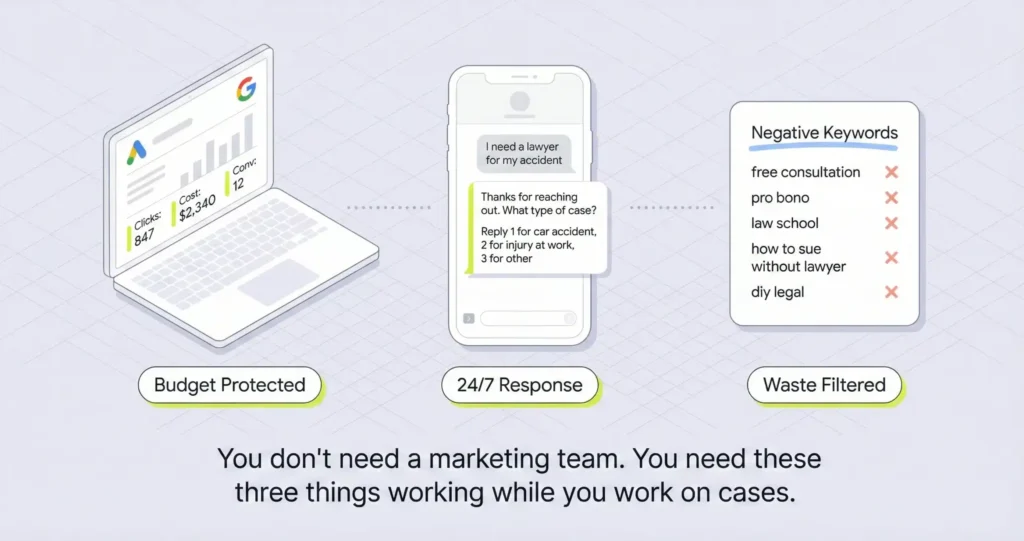

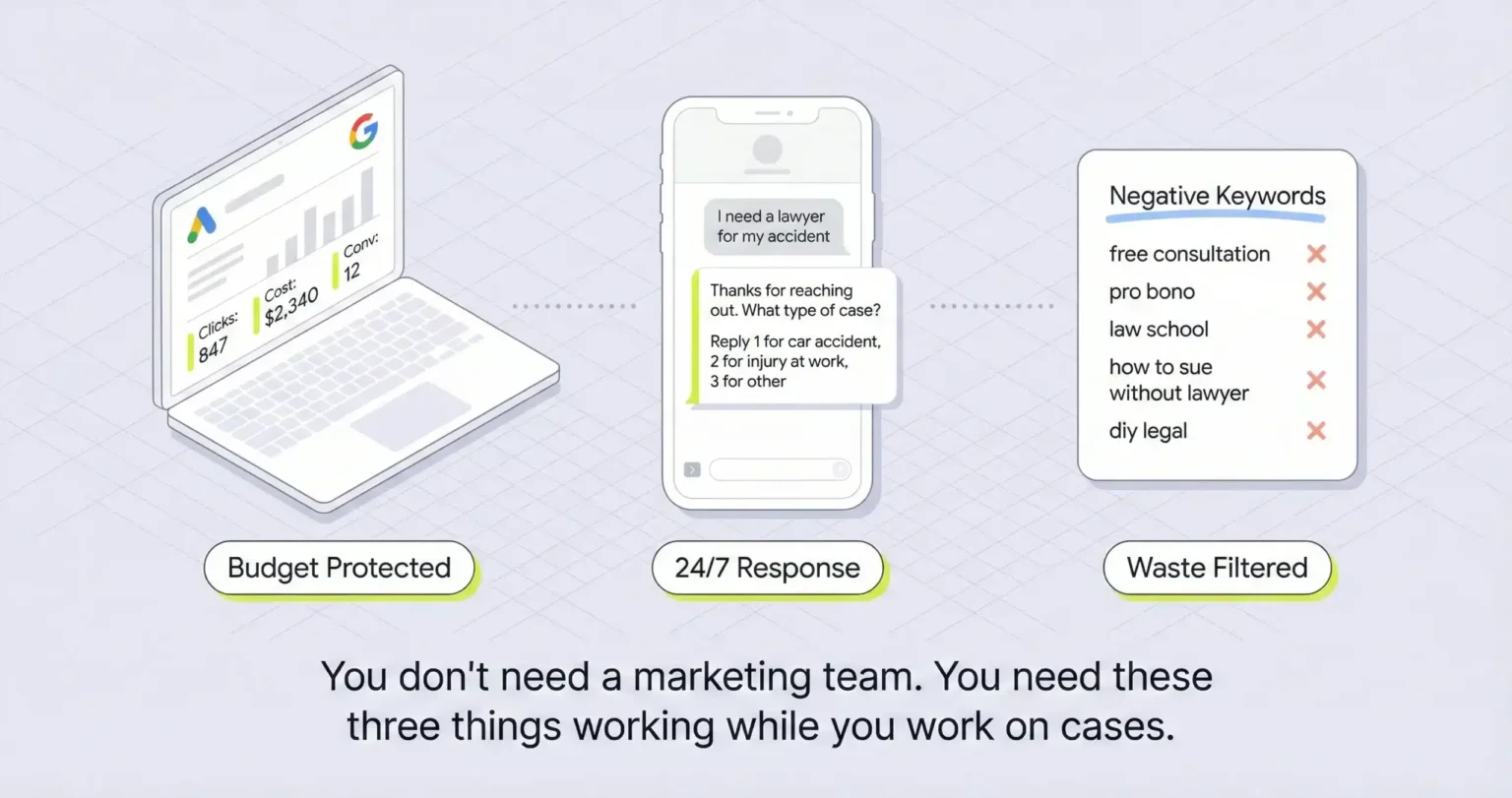




How can a solo attorney generate quality leads on a tight budget? Stop competing on the same broad keywords as firms spending $50,000 a month. Instead, build campaigns around specific scenarios your ideal client searches for, protect your budget with aggressive negative keyword lists that block free-seekers and job-hunters before they click, target your ads to the specific neighborhoods where your clients are, and set up automated intake so leads get a response even when you’re in court. The math works differently for solos because you don’t need 200 leads a month; you need maybe 3 to 5 good ones, and the strategy should reflect that.
Small budgets produce better leads per dollar than big ones and that sounds backwards but the math holds up. When you can only afford 10 clicks a day you pick your keywords carefully, you write ads that filter out the wrong people before they click, and every dollar has a job. When the budget grows to 200 clicks a day the targeting gets lazy, the keywords get broader, and the cost per signed case creeps up even though the lead volume looks better on the report. The discipline of having no room for waste is the thing that most firms lose the moment they can afford to be less careful.
The channel selection and budget allocation under $2,000 pieces cover the strategic layer. This one is the tactical layer underneath; the specific moves that keep a small budget from getting eaten by irrelevant clicks, missed calls, and the kind of broad match keyword creep that turns a $2,000 monthly spend into $1,400 worth of people who were never going to hire you.
The Negative Keyword List Is the Most Important Thing You’ll Build
What are negative keywords and why do solo attorneys need them? Negative keywords prevent your ad from showing when someone includes a specific word in their search. If you’re a criminal defense attorney and someone searches “criminal defense internship,” a negative keyword on “internship” stops your ad from appearing and saves you the click cost. For a solo attorney spending $1,500 to $2,500 a month on ads, a single week without a good negative keyword list can waste 30 to 40% of the budget on clicks from people looking for free advice, legal jobs, DIY forms, or definitions.
This is the thing that separates solo attorneys who make ads work on a tight budget from the ones who quit after three months saying Google Ads doesn’t work for lawyers. The ads work fine, the targeting just wasn’t specific enough.
The categories I build negative lists around are pretty consistent. Job-seekers are the biggest waste; words like “salary,” “internship,” “job,” “careers,” “paralegal,” and “resume” should be blocked on every campaign because people searching “family law paralegal salary” are not looking for a lawyer. Free-seekers are next; “free,” “pro bono,” “legal aid,” and “low income” all need to be excluded unless that’s who you’re trying to serve.
Then there’s informational traffic; “what is,” “definition,” “template,” “form,” “DIY,” and “wiki” all indicate someone doing research, not someone ready to hire. And I usually exclude competitor names too because on a tight budget, clicks from people looking for a specific other firm just end in a confused phone call and a wasted $40.
At Percy we didn’t start with a negative list, it took a few weeks of reviewing the search terms report and planning it out before we understood what was eating the budget. Once we built one the waste dropped fast, and looking back the money we spent before that on clicks from people searching for legal jobs and free consultations.
Why Broad Keywords Are a Budget Trap for Solos
Should solo attorneys bid on broad keywords like “divorce lawyer”? Almost never. A keyword like “divorce lawyer” in a mid-size city might cost $30 to $80 per click and attracts everyone from someone ready to hire today to someone writing a college paper. A solo with $2,000 a month can afford maybe 30 to 60 clicks on a term like that, and if the conversion rate is 3 to 5% that’s maybe 1 to 3 leads, and most of those leads will be unqualified. Scenario-based long-tail keywords like “father’s rights custody lawyer” or “failed breathalyzer test defense” cost less per click, attract people with a specific problem who are ready to hire, and convert at higher rates because the ad matches exactly what they’re searching for.
The research calls this “long-tail strategy” but really it’s just matching your ad to a specific problem instead of a general category. A solo doesn’t need 1,000 clicks a month. You probably need 3 to 5 signed cases a month to run a healthy practice, which means you need maybe 30 to 50 real conversations, which means you need maybe 100 to 200 clicks that actually come from people with a problem you solve. That math changes how you think about every keyword decision you make.
What I’ve seen work better for solos is building campaigns around scenarios instead of practice areas. Not “personal injury” but “uber accident injury.” Not “criminal defense” but “DUI with commercial license.” Not “estate planning” but “estate plan for blended family.” Each one is a small campaign that might only get a few clicks a week, but those clicks come from people who already know they need exactly what you do, and the conversion economics look nothing like what you’d see on a broad campaign.
Practice Areas Where the Click Costs Don’t Destroy You
What legal practice areas have the lowest advertising costs for solo attorneys? The cost per click varies wildly by practice area. Personal injury and mass tort keywords can run $100 to $1,000 per click in competitive markets, which is unworkable for most solos. But areas like expungement, estate planning, bankruptcy, consumer protection, and certain family law sub-specialties often cost under $30 per click because the big PI firms aren’t competing there. The strategy for a solo is to find the practice areas where client value is decent but big-firm interest is low, and build a targeted presence there.
I think this is the part most solos miss because they see the high case values in PI and assume that’s where the money is, but the advertising cost to get those cases is so high that it only works at scale. The math for a solo is different.
The research points to some interesting micro-niches where competition is low and clients are motivated. Expungement is one; the person wants their record cleared for a job and they’re ready to pay a flat fee, and the keywords are cheap because big firms don’t bother. QDROs; which are the retirement account division orders in divorce cases; are another because most divorce attorneys hate the paperwork and refer it out. Partition actions, where co-owners disagree about selling a property, is another one with almost no ad competition in most markets.
I’m not saying to build your whole practice around one obscure niche, but having a channel strategy that includes at least one lower-competition practice area lets you generate leads at a cost that actually makes sense while you build toward the more expensive ones.
Making Sure You’re Not Running Ads While You’re in Court
How should solo attorneys handle leads when they can’t answer the phone? Set up automated intake that triggers the moment someone contacts you. An immediate text and email acknowledging the inquiry, a link to schedule a consultation on your calendar, and a short intake form that collects the basics before the call. This costs maybe $50 to $150 a month in software and it solves the biggest problem solos have with paid ads, which is that the lead comes in while you’re in a hearing and by the time you call back 3 hours later they’ve already hired someone who picked up the phone.
The data on response time is consistent across every study I’ve seen; leads contacted within 5 minutes convert at dramatically higher rates than leads contacted an hour later, and for solos this is the single biggest leak in the system because you physically can’t answer every call the moment it comes in.
The automated response doesn’t replace the actual conversation, it just holds the person’s attention until you can have it. Something like “I got your message and I’m reviewing it now, I’ll call you by 3pm today” is enough to keep most people from calling the next lawyer on the list. And a self-scheduling link in that message lets the motivated ones book a time without waiting for you, which means by the time you get out of court you’ve got consultations on your calendar instead of voicemails you’re racing to return.
The other piece is dayparting, which just means turning your ads off during hours when nobody is available to respond. If you don’t have a virtual receptionist and you’re in court every morning, running ads from 8am to noon is burning budget on leads you can’t catch. Align the ad schedule to your actual availability and you stop paying for missed opportunities.
What to Do When You Only Get 50 Clicks a Month
How can solo attorneys evaluate their marketing with limited data? You can’t run traditional split tests with 50 clicks a month because the sample is too small for statistical significance. Instead, use what you already know. If the first 5 leads from a campaign are all asking for free consultations, you don’t need 100 more data points to know the targeting is wrong. If your landing page gets 50 clicks and zero calls, the industry average says you should be getting 3 to 4, so something is off. The advantage solos have is that you talk to every lead yourself, which means you get qualitative data that big firms running thousands of leads through a call center never see.
I think this is actually where solos have an edge that they don’t realize. When you’re the person on the phone with every prospect, you know within a week whether a campaign is pulling the right people or the wrong people, and you don’t need a spreadsheet to tell you. The person at a big firm looking at an aggregate dashboard can’t tell you that the last 3 leads from Campaign B were all tire-kickers asking about payment plans; you can.
The practical version of this is simple. Score every lead that comes in on two things; could they hire you, and did they match the kind of case you were targeting. After two weeks, if a campaign is producing contacts but none of them match, change the keywords or the ad copy. After a month, if a campaign is producing matches but none of them are converting to consultations, the problem is probably your intake process or your landing page, not the ads. You don’t need 1,000 data points to make these calls when you’re the one having the conversations.
Not sure if your ad budget is going to the right places?
Send me what you’re spending and where, and I’ll tell you what I’d change. If the setup is working I’ll say so. If it’s not, you’ll know where the waste is.