

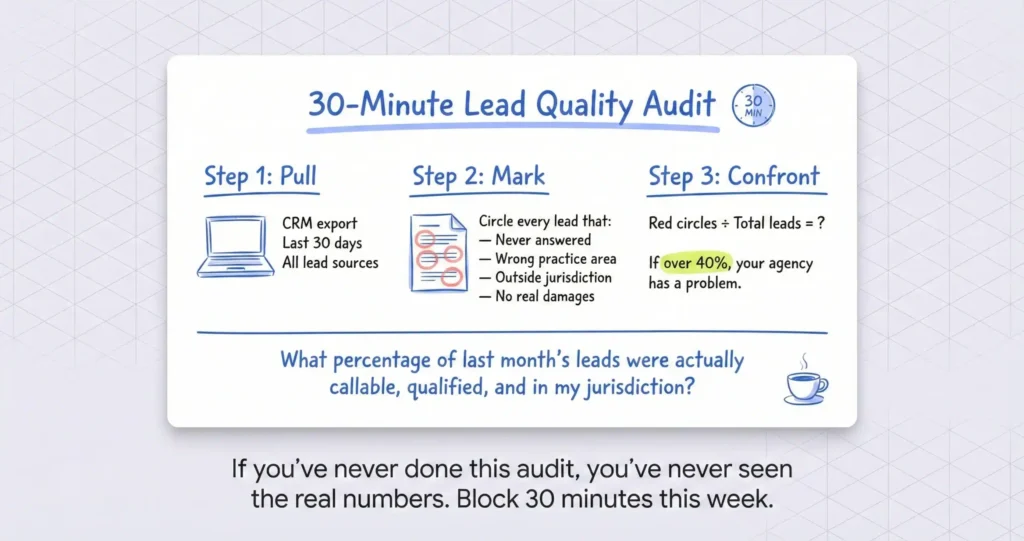

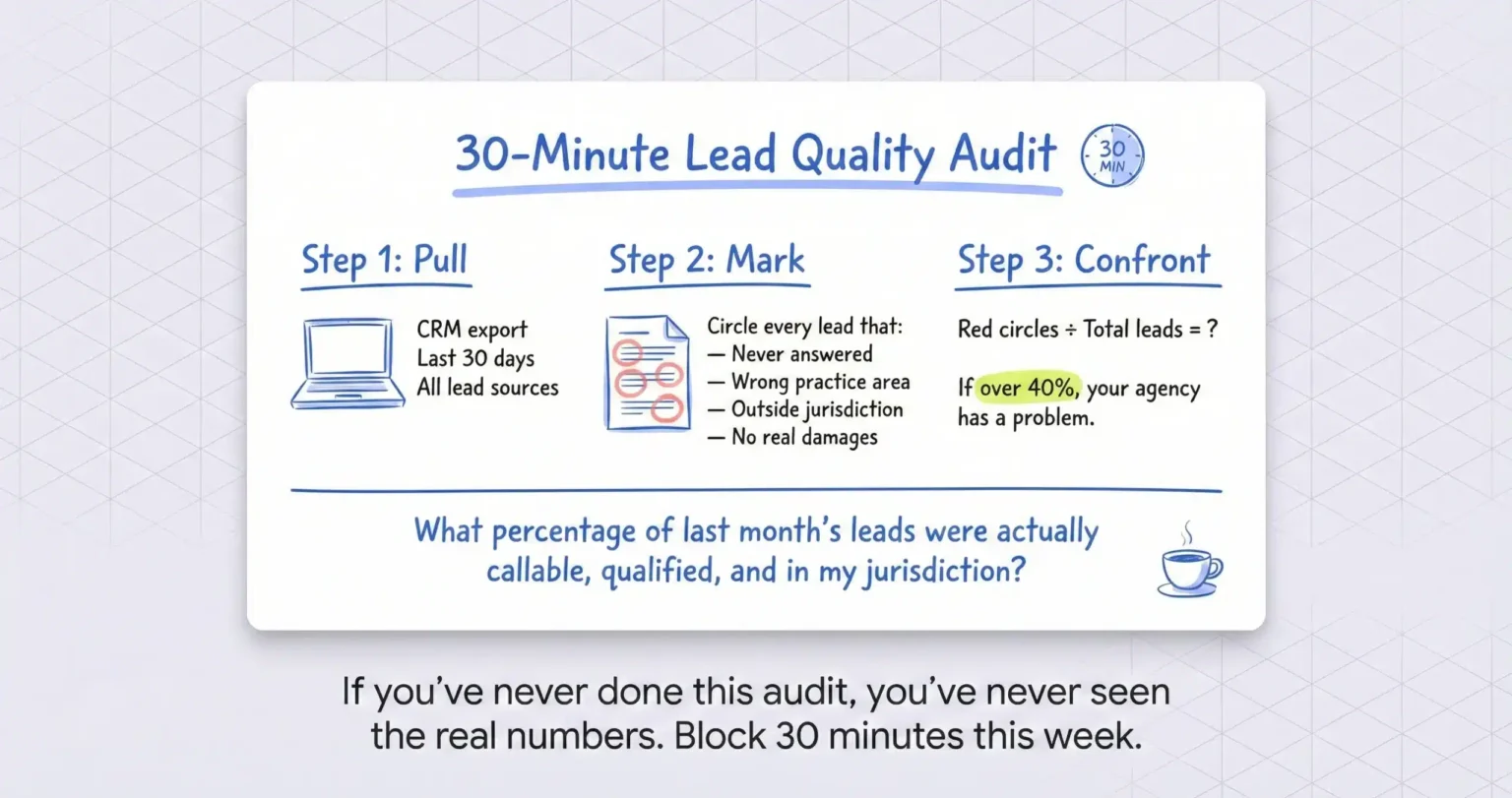




How do you audit your marketing agency’s lead quality in 30 minutes? Check four things monthly. First, where the leads actually came from and whether the source data is clean or hidden. Second, how many of those leads your team was able to reach, because in med mal anything below 55% contact rate means something is wrong with the source. Third, whether the leads match the type of case your firm actually takes, not just “someone with a medical complaint.” Fourth, what you really paid per signed case when you add up the full spend and divide by retainers, not the cost per lead number your agency puts on the report.
A $150 cost per lead on med mal should be a red flag, not a selling point. Genuine med mal search terms like “failure to diagnose cancer attorney” or “birth injury lawyer” cost $70 to $250 per click just to get someone to your site, so if the leads are coming in at $150 each the math only works if the keywords pulling them in are cheap and broad, which usually means the firm is getting calls about billing complaints and bedside manner grievances instead of actual malpractice cases.
And cost per lead hides the real number anyway. If a hundred of those $150 leads produce one signed case, the actual cost per signed case is $15,000, and that’s before the firm spends anything on nurse reviews and records retrieval for the 99 that went nowhere. The lead looked cheap on the agency’s report but the case it eventually produced was expensive by the time you add up everything the firm touched along the way, which is why cost per signed case is the only metric that tells you what marketing actually costs.
Check Where the Leads Actually Came From
How do you verify where your marketing agency’s leads originated? Look at the source data in your lead tracking system for the last 30 days. Every lead should carry tracking information showing exactly which ad, keyword, or page brought them in. If a large percentage show up as “direct” or “unknown” with no source attached, your agency may be stripping that data to hide the fact that leads came from cheap third-party sources instead of the campaigns you’re paying for. Also check the ratio of leads from your own website versus leads purchased from outside directories; if outside leads make up more than 60% of volume but less than 20% of signed cases, the agency is padding numbers with low-quality contacts.
Most firms skip this step because it feels technical, but it catches the biggest problems. Whatever system you use to track leads; Filevine, Lead Docket, Salesforce, whatever; it should show where each lead came from, which keyword, which ad, which platform. If that data is missing or says “direct” for a bunch of leads that should have come from paid ads, something is being hidden and you should ask about it directly.
I also tell firms to check for fake submissions. In med mal the keywords are so expensive that they attract bots and agencies that pad the numbers with junk to make the volume look better. If you see forms that were filled out in under 10 seconds, or email addresses that follow a pattern like john.doe1, john.doe2, john.doe3, or multiple leads from the same internet address in the same hour, those aren’t real people and they shouldn’t be counted in the numbers your agency shows you.
Check How Many Leads Your Team Could Actually Reach
What contact rate should a med mal firm expect from marketing leads? Between 55 and 65 percent, which is lower than personal injury where 75 to 85 percent is normal. Med mal contact rates are naturally lower because the patient or their family member may be hospitalized, sedated, or dealing with an ongoing medical situation when they submit the form. Someone else may have filled it out on their behalf. The psychological weight of confronting a doctor also causes some people to pull back after submitting. But if your contact rate drops below 40%, that’s not the nature of med mal cases; that’s a sign the leads are fake, recycled, or incentivized and the source needs to be cut.
Once you know the leads are real, the next question is whether your team can actually get them on the phone, and this is the part that catches med mal firms off guard because they’re used to PI numbers where you reach 4 out of 5 people, and when their med mal contact rate comes in at 60% they think something is broken. It’s not broken, it’s just a harder population to reach for real reasons.
But below 40% is a different story. If your intake team can’t get more than 4 out of 10 leads on the phone, those leads were probably never real contacts to begin with; they’re “incentivized” form fills from people clicking things for mobile game rewards, or aged data that got resold as fresh, and your agency should be able to explain why the numbers are that low.
Check Whether the Leads Match Cases You Can Actually Take
How do you tell if your agency is sending the right type of med mal leads? Look at the last 20 leads your firm rejected and ask why. If most were rejected because the person had a complaint but no actual malpractice; a rude doctor, a long wait, a known complication from a surgery they consented to; then your agency is running broad keywords that attract grievances instead of cases. If the leads describe real injuries but the liability is unclear, the targeting is better but the ad copy needs to do more pre-qualifying. The leads that matter are the ones where both the injury is serious and the negligence is identifiable; wrong-site surgery, retained instruments, failure to diagnose something that should have been caught.
Reaching the person is one thing, but whether they have a case you can actually take is where the general lead quality framework and the med mal version split apart, because in PI you’re mostly asking “was there an accident and who was at fault” but in med mal you’re asking a much harder question about whether the doctor fell below the standard of care, and most people calling don’t know the difference between a bad outcome and actual negligence.
If your agency is bidding on broad terms like “medical injury lawyer” to keep the volume up, they’re going to fill your intake queue with people who are upset about something medical but don’t have a case, and your intake team burns out screening 95 calls to find 5 worth reviewing. The better agencies target specific injury scenarios; “cerebral palsy birth injury attorney” or “failure to diagnose sepsis lawyer,” terms where the person already knows something went wrong and can describe it.
Check What You’re Actually Paying Per Signed Case
How do you calculate your real cost per signed med mal case? Take your total marketing spend for the last 90 days and divide by the number of cases you signed from those leads. Not the leads delivered, not the leads contacted, not the leads reviewed; the cases signed. If you spent $20,000 and signed one case, your cost per signed case is $20,000. Whether that’s acceptable depends on what that case is likely to be worth. A birth injury case projected at $5 million makes $20,000 look like nothing. A missed fracture case worth $150,000 makes $20,000 look like a problem.
The reason I say 90 days instead of 30 is because med mal leads take longer to convert than PI. A lead that comes in January might not sign until March or April because your team needs to pull records, have a nurse review them, and decide whether there’s a case worth pursuing. If you evaluate this month’s marketing based on this month’s signings, you’ll always undervalue the agency because you’re not giving the leads enough time to work through your pipeline.
The part most firms miss is the triage cost. In PI, a lead that doesn’t work out costs you 12 minutes of intake time and that’s it. In med mal, a lead that passes initial screening but fails the medical review might cost you $2,000 in nurse reviews and records retrieval before you reject it. When your cost per signed case hits $15,000 or $20,000, a chunk of that is the triage on the cases that didn’t make it, and better lead quality at the front end is the only way to bring that number down.
Want me to run this audit on your current leads?
Send me your last 90 days of lead data and I’ll check all four areas; source integrity, contact rates, case-type match, and real cost per signed case. If the numbers look healthy I’ll tell you. If there’s a problem hiding in the data, you’ll have something specific to bring to your agency instead of a gut feeling.