Google Just Put an AI Answer Above Your #1 Ranking
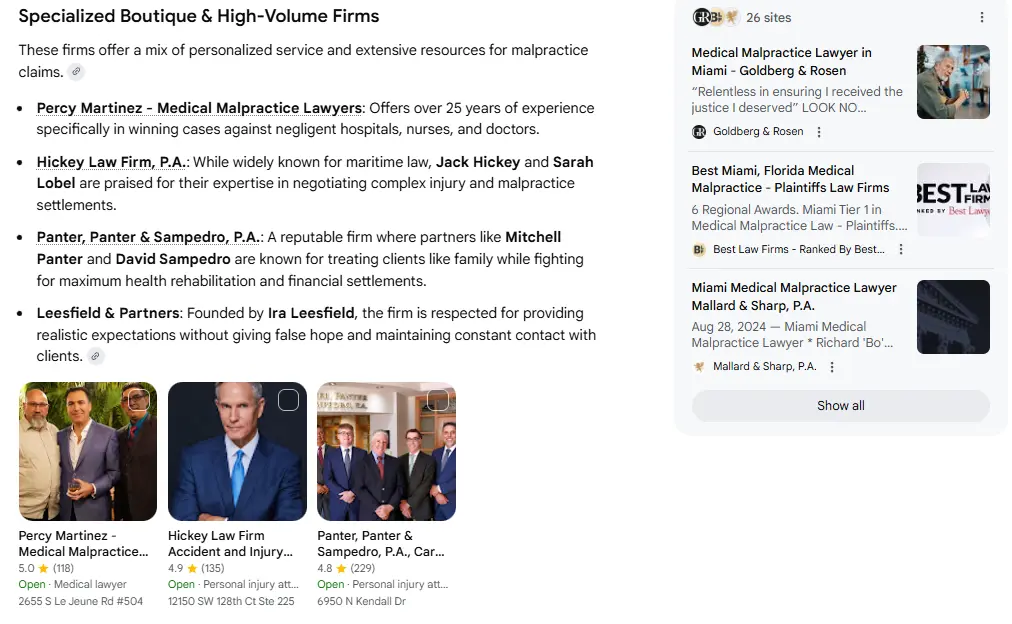
You spent two years getting to page one. Now Google shows an AI Overview that answers the question before anyone clicks your link. ChatGPT recommends three Miami firms when someone asks for a lawyer. Your SEO doesn’t control whether you’re one of them.
Generalist agencies add “AI optimization” as a bullet point. We build your visibility strategy around it. And we do something nobody else in Miami offers: multilingual entity optimization so you show up when someone asks ChatGPT “mejor abogado de accidentes en Miami.”
Your Spanish Market Is Wide Open in AI
Summary: Spanish-language AI entity optimization for Miami lawyers is nearly uncontested. ChatGPT and Google AI respond to Spanish legal queries but no agencies are actively optimizing entity signals for these responses. 66% of Miami-Dade speaks Spanish at home. Multilingual entity optimization builds consistent, authoritative Spanish-language knowledge graph entries that AI models retrieve and cite.
Ask ChatGPT “mejor abogado de lesiones personales en Miami” right now. You’ll get an answer. Specific firm names. Reasons why.
Who’s optimizing the entity signals that influence that answer? Almost nobody.
66% of Miami-Dade speaks Spanish at home. Those queries are moving to AI assistants just like English ones. The firms with strong Spanish-language entity presence will capture that market.
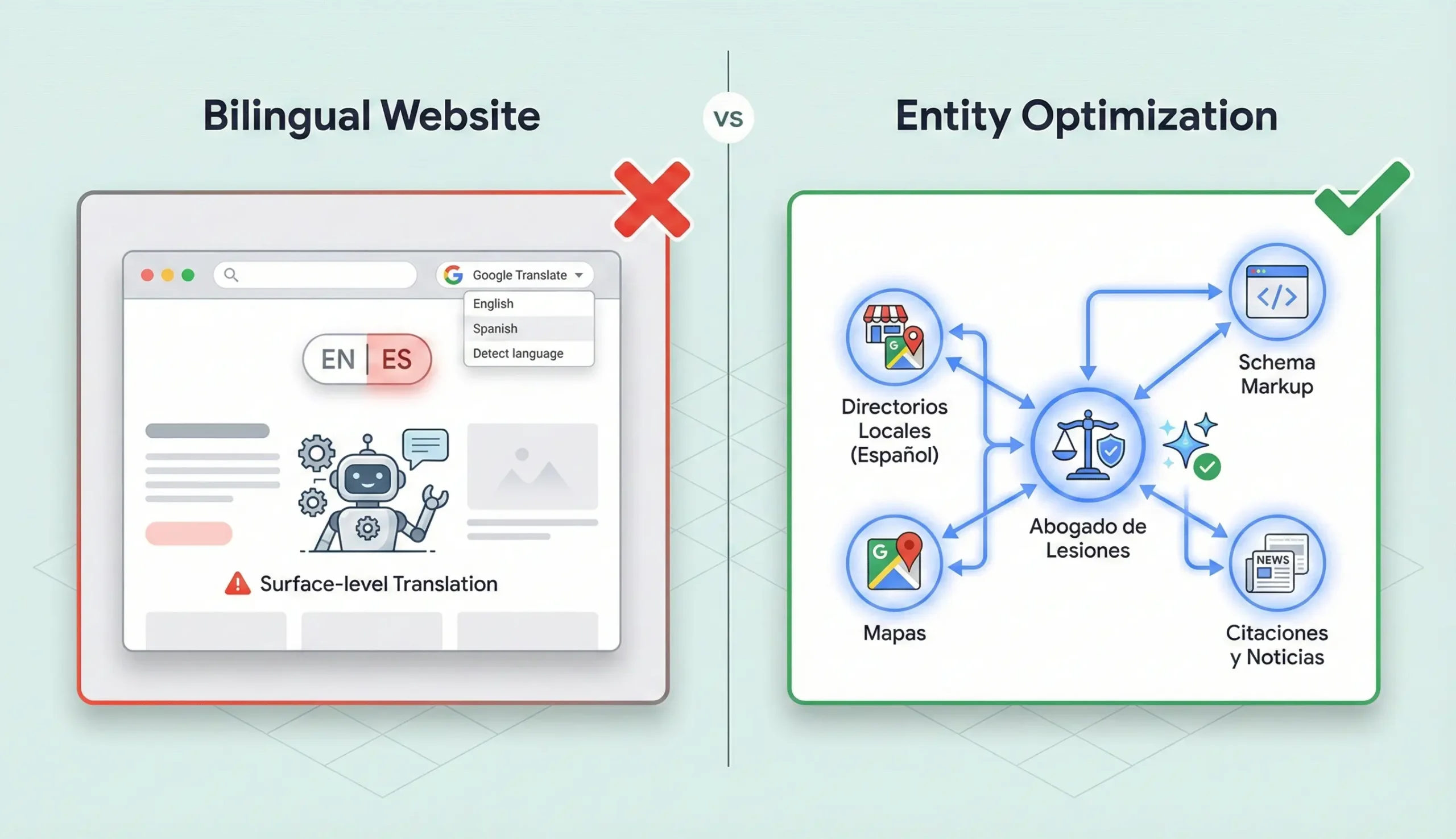
This requires what we call Multilingual Entity Optimization. Not translation. Not “training” the AI (that’s technically impossible). Building consistent, authoritative Spanish-language signals across the sources AI models actually retrieve: directories, news citations, schema markup, and knowledge graph entries.
When a user queries in Spanish, AI models prefer to retrieve and cite sources originally in Spanish. They’re semantically closer to the query than translated English content. A firm listed only in English directories is invisible to Spanish queries.
The Spanglish variable matters too. Miami Spanish is dialectically distinct. Standard Castilian optimizations miss the mark. Schema markup needs alternateName entries with local terms: “abogado de accidentes” not just “letrado de lesiones.”
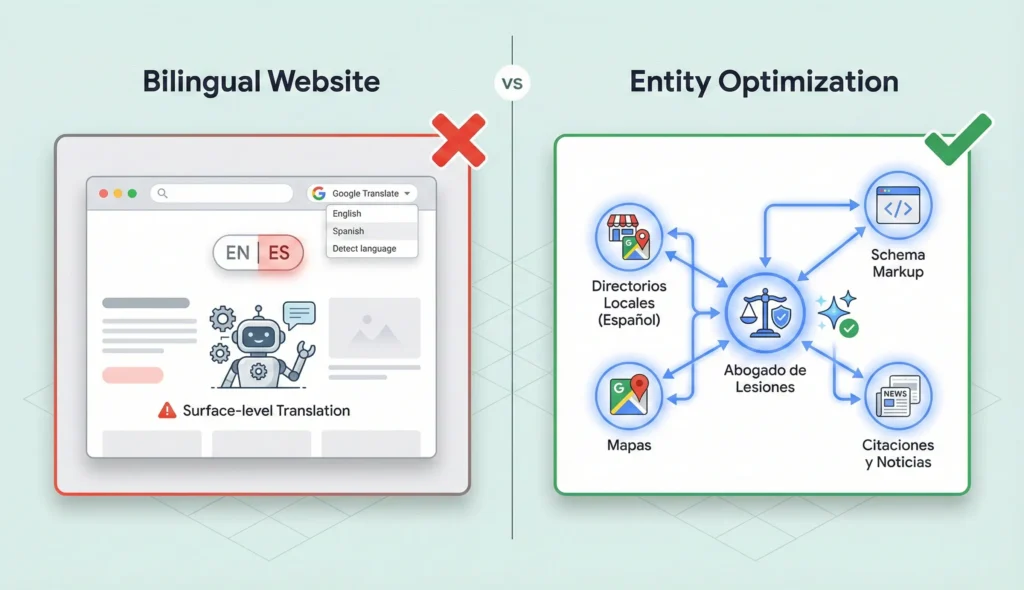
Your competitors haven’t figured this out. The big agencies mention “bilingual websites.” That’s translation. We’re talking about building a bilingual entity that AI models recognize as one authoritative source across both languages.
What GEO Actually Means
Summary: GEO (Generative Engine Optimization) targets how AI models select and cite sources. Different from traditional SEO which optimizes for ranking algorithms. GEO optimizes for synthesis engines. Includes entity clarity via schema markup, citation building on AI-trusted sources, content structuring for Retrieval Augmented Generation (RAG), and knowledge graph optimization. AI models prioritize semantic coherence and citation worthiness over keyword frequency.
Traditional SEO gets you ranked. GEO gets you cited.
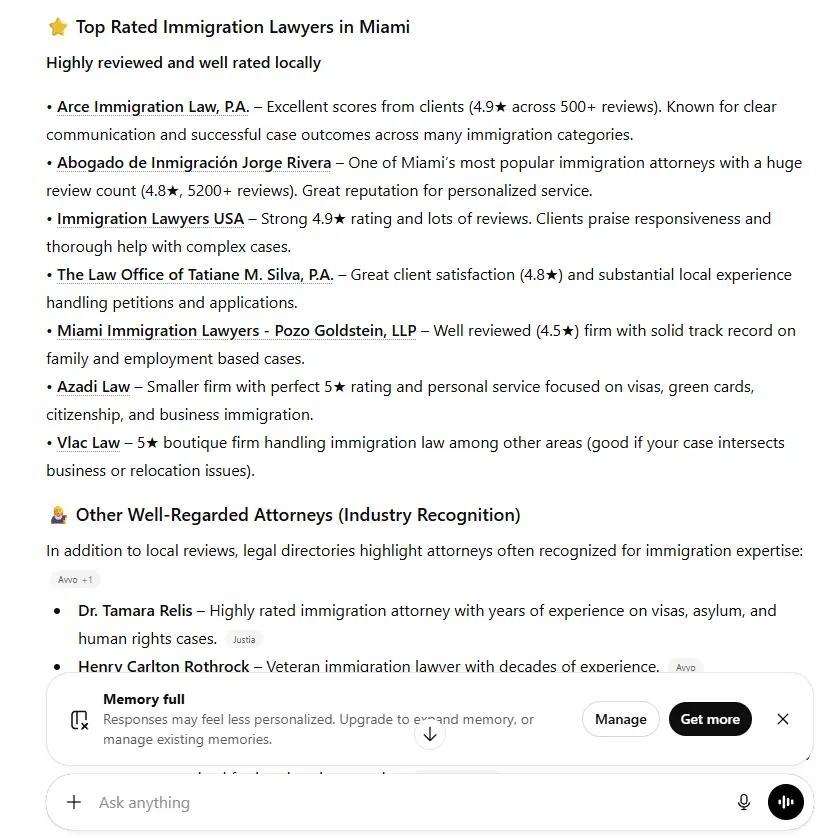
When someone asks ChatGPT “who’s the best immigration lawyer in Miami,” it doesn’t show 10 blue links. It retrieves documents from its search index, reads them, and synthesizes an answer naming specific firms. Your organic ranking doesn’t determine whether you’re mentioned. Your entity clarity and citation worthiness do.
Entity clarity. AI models need to recognize your firm as a defined entity. This means Person schema for attorneys, LegalService schema for the firm, knowsLanguage markup for bilingual capability, and consistent NAP across every platform. Conflicting data across directories makes you an unreliable source.
Citation building upstream. AI retrieves from high-authority sources: legal directories like Super Lawyers, news sites, government databases. The battle moved upstream. You’re not optimizing for the search result anymore. You’re optimizing for the data sources that feed the search result.
Content structuring for RAG. Retrieval Augmented Generation means AI reads your content and extracts answers. Direct answers to questions get cited (“The statute of limitations for negligence in Florida is four years”). Marketing fluff gets ignored. AI summarizes. It doesn’t repeat your keywords.
Knowledge graph optimization. Google’s AI Overviews pull from its knowledge graph. If your firm isn’t properly represented there with verified attributes, you’re invisible regardless of organic ranking.
Response monitoring. Weekly tracking across ChatGPT, Google AI, Perplexity, and Claude. Identifying gaps, inaccuracies, and citation opportunities.
The Shift That’s Already Happening
Summary: AI Overviews trigger for approximately 16% of all queries and over 90% for informational queries. When AI Overviews appear, organic CTR drops 61-65%. Users adopt “look and leave” behavior: read the AI summary, extract the fact, close the tab. The cited website gets attribution but no visit. Traditional SEO remains necessary but insufficient.
AI Overviews trigger for about 16% of all Google searches. For informational queries like “Florida negligence laws,” the trigger rate exceeds 90%.
When an AI Overview appears, organic click-through rate drops 61-65%. Users read the summary, extract what they need, and leave. Your website might be cited, but nobody visits it.
ChatGPT has 200 million weekly users. Many ask for professional recommendations. The model doesn’t show 10 options. It synthesizes a shortlist of one to three firms.
Your competitors see this happening. The question is whether they’re doing anything about it.
Some agencies list “GEO” on their service pages now. Most treat it as an add-on. A bullet point in a proposal. They optimize blog posts and hope that’s enough.
We build your entire visibility strategy around this shift. Because firms who establish strong entity signals now will compound that advantage as models update and citation patterns reinforce. Traffic from AI citations converts at higher rates because users view the AI’s recommendation as a trusted endorsement, not an advertisement.
What This Looks Like in Practice
Summary: GEO engagement includes initial AI visibility audit, entity optimization, citation building, content restructuring, schema implementation, and monthly monitoring. Month 1: audit and foundation. Months 2-3: entity and citation building. Months 4-6: monitoring, Spanish expansion, adjustment. Ongoing: maintenance as AI models update.
Month 1: Audit and foundation. Where does your firm appear in AI responses right now? Where are competitors appearing? What sources are AI models citing for Miami legal queries? We map the entire landscape before building.
Month 2 to 3: Entity and citation building. Structured data implementation. Directory optimization. Outreach for mentions on AI-trusted sources. Content restructuring for extraction. Spanish entity training begins.
Month 4 to 6: Monitoring and expansion. Weekly AI response tracking. New citation opportunities identified. Spanish-language optimization expands. Adjustments based on what’s working.
Ongoing: Maintenance and defense. AI models update constantly. Citation patterns shift. Competitors eventually enter this space seriously. Maintaining visibility requires ongoing attention.
By Practice Area
Summary: AI search volume and competition varies by practice area. Immigration has highest AI query volume, especially Spanish-language. Personal injury has significant volume with growing AI Overview presence. Medical malpractice has lower volume but high-intent queries. Family law users increasingly prefer AI for privacy. Criminal defense has urgent real-time patterns.
Immigration leads AI search activity for Miami legal queries. People ask AI about visa processes, asylum procedures, attorney recommendations constantly. Spanish-language immigration queries are especially active and underserved.
Personal Injury generates significant AI volume. “What should I do after a car accident in Miami” gets asked to AI assistants daily. Google AI Overviews appear for most PI queries now.
Medical Malpractice has lower volume but high intent. Someone asking AI about medical malpractice lawyers is serious. These citations convert.
Family Law queries to AI are growing because people find it less embarrassing than searching publicly. Divorce questions, custody questions, attorney recommendations.
Criminal Defense has urgent patterns. Someone asking Siri “Miami DUI lawyer” at 2am wants immediate recommendations. AI responds with firm names.
What It Costs
Summary: Miami law firm GEO costs $2,500 to $5,000 per month depending on practice area and scope. Market rates for comprehensive GEO range from $1,500 to $10,000+. Higher end for competitive practice areas or full bilingual optimization. Includes entity optimization, citation building, knowledge graph work, schema implementation, and monthly monitoring. 6-month minimum.
$2,500 to $5,000 per month depending on scope.
Higher end for competitive practice areas (PI, immigration) or full multilingual entity optimization. Lower end for niche practice areas or single-language focus.
What’s included: Entity optimization with proper schema markup (Person, LegalService, knowsLanguage). Citation building on AI-trusted sources through digital PR. Knowledge graph optimization. Content restructuring for RAG retrieval. Multilingual entity consistency across English and Spanish. Monthly monitoring across ChatGPT, Google AI Overviews, Perplexity, and Claude.
6 month minimum commitment. AI visibility compounds over time as citation patterns reinforce. Short engagements don’t produce measurable results.
Why this pricing: Comprehensive GEO that actually influences the knowledge graph requires manual outreach, digital PR, and technical schema work. Cut-rate “GEO” services that promise automated optimization lack the depth to influence how AI models retrieve and cite sources.
One Firm Per Practice Area
Summary: One Miami-Dade law firm per practice area for GEO services. Cannot optimize competing firms for the same AI citations. AI recommendations are zero-sum: when you enter the top 3, someone else exits. Current availability listed by practice area.
AI optimization is zero-sum.
When ChatGPT recommends three firms for “best personal injury lawyer in Miami,” getting into that list means someone else drops out. I can’t optimize two PI firms for the same AI citations.
Current Miami Dade Availability:
| Practice Area | Status |
|---|---|
| Immigration | Open |
| Personal Injury | In Discussion |
| Medical Malpractice | Closed |
| Family Law | Open |
| Criminal Defense | Open |
See Which Firms AI Recommends Instead of You
I’ll run your top practice area queries through ChatGPT, Google AI Overviews, Perplexity, and Claude. You’ll see the 3 firms AI recommends, why it recommends them, and where you’re missing. Takes 20 minutes. No cost.
Verify My Background:
Full AI optimization services | Miami SEO | Miami PPC | Web Design Miami | Review Management Miami