








Key Takeaways (TL;DR)
- The only metric that matters is Cost Per Signed Case; not clicks, not leads, not impressions
- 30-55% of signed cases at law firms can’t be traced to any specific marketing channel
- Personal injury cost per lead ranges $500-$1,500 for quality search traffic; cost per signed case runs $3,500-$7,500
- Your agency should not own your accounts if you can’t fire them without losing your data, you don’t own it
- Bar compliance is your liability, not theirs; if they use “Expert” without Board Certification, you face the ethics complaint
Table of Contents
The report says traffic is up and leads are up and cost per lead is down and every chart has a green arrow pointing in the right direction, and then the managing partner asks “so why aren’t we signing more cases” and nobody in the room can answer that question. Not the agency, not the marketing director, not the intake team. The data looks good and the outcomes don’t match and the gap between those two things is where most firms lose confidence in marketing entirely.
That gap exists because the agency is measuring one thing and the firm is measuring a different thing and neither side has built the connection between them. The agency reports clicks and calls and form fills because that’s where their job ends. The firm cares about signed retainers and collected fees because that’s where the revenue lives. And the evaluation most attorneys run on their agency is basically “do I feel like this is working,” which isn’t an evaluation, it’s a guess with a monthly retainer attached to it.
This is the framework for turning that guess into an actual answer. Not whether the marketing looks busy, but whether the cost to acquire a signed case makes financial sense given what that case is worth to the firm, which is a question that has a real number attached to it if you know where to look.
The Only Metric That Actually Matters
Summary: Cost Per Signed Case (CPSC) = Total Marketing Spend ÷ Total New Retainers. This is the only metric that tells you if marketing is actually working. Most agencies report clicks and leads because those numbers always go up; but clicks don’t pay bills and leads don’t sign retainers.
Agencies love reporting impressions, clicks, and leads because those numbers always go up. More people saw your ad this month than last month. More people clicked. More people filled out a form. Great.
But here’s the question nobody asks: What’s your cost per signed case?
Not cost per click. Not cost per lead. Cost per signed case; meaning total marketing spend divided by total new retainers.
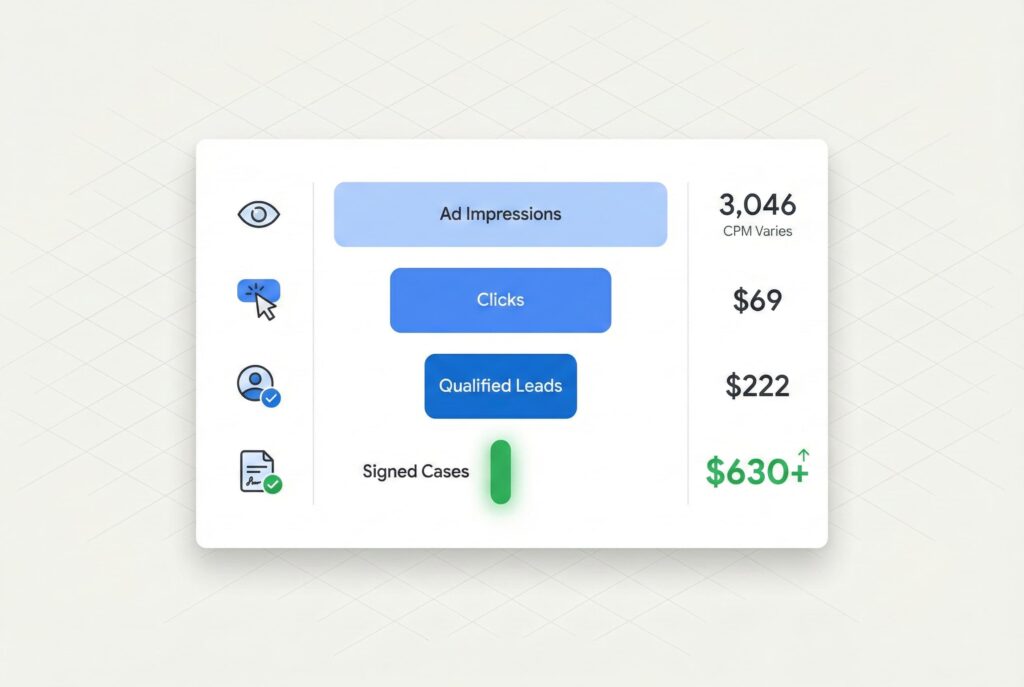
I’ve seen firms spending $10,000 a month who couldn’t answer this question. Their agency sent beautiful reports with graphs showing upward trends, but when I asked how many of those leads turned into actual clients, nobody knew.
Industry data shows 30-55% of signed cases at law firms can’t be traced to any specific marketing channel. That means more than half your clients walked in the door and you have no idea which ad or which keyword or which campaign brought them there. And if you don’t know that, you can’t possibly know if your marketing is working.
Related: What does law firm PPC actually cost?
What the Numbers Should Actually Look Like
Summary: Personal injury Google Ads benchmarks (US, 2025): CPC $100-$300+, Cost Per Lead $500-$1,500, Cost Per Signed Case $3,500-$7,500 for search campaigns. Local Services Ads convert at 34% with CPL $195-$250, resulting in cost per signed case of $630-$735. Anyone promising $150 PI leads from search is blending low-quality display traffic.
Here’s what a healthy funnel looks like for Personal Injury, based on 2025 US benchmarks:
Personal Injury (Google Ads Search):
- Average cost per click: $100-$300+ (major metros can exceed $300)
- Click to lead conversion: 5-15%
- Cost per lead: $500-$1,500 (quality car accident leads)
- Lead to signed case: 10-20%
- Cost per signed case: $3,500-$7,500 (search campaigns)
The math: $750 CPL ÷ 15% conversion = $5,000 per signed case. That’s the reality for high-intent search. Agencies quoting $2,500 cost per case are either running branded search (people already looking for you), blending in low-quality display traffic, or not tracking to actual signed retainers.
If someone promises you $150 leads for PI search campaigns, they’re either blending in low-intent display traffic or lying. Quality PI leads from high-intent search are expensive. That’s the reality.
Other Practice Areas:
- Bankruptcy: ~$82 CPL (lower competition, lower case values)
- Criminal Defense: Higher urgency = faster conversion
- Family Law: $100-$200 CPL range
Local Services Ads (Google Screened):
- Cost per lead: $195-$250
- Conversion to retainer: ~34%
- Resulting cost per signed case: $630-$735
LSAs cost more per lead but convert at much higher rates because trust signals are built in. A $250 LSA lead that converts at 34% beats a $150 search lead that converts at 8%.
The Attribution Problem Nobody Talks About
Summary: Up to 60% of law firm marketing budgets are wasted due to poor attribution. Agencies must have: (1) Dynamic Number Insertion for call tracking, (2) CRM integration with practice management software, and (3) Speed-to-lead automation; leads waiting over 10 minutes are significantly less likely to convert, and 80% leave after 48 hours without response.
Here’s a dirty secret: up to 60% of law firm marketing budgets are wasted because firms can’t tie revenue back to the specific spend that generated it.
Your agency should be able to answer these questions:
Do you have dynamic number insertion (DNI)? This is call tracking that tells you which specific keyword or campaign generated a phone call. Without it, you know someone called but not which ad made them call.
Is your tracking integrated with your practice management software? Your agency should be pushing data into Clio or MyCase or whatever you use, not just tracking in their own isolated dashboard. You need to see the full lifecycle: ad spend → click → lead → consultation → signed case → case value.
What’s your speed-to-lead? Data shows leads who wait more than 10 minutes are significantly less likely to convert. 80% will move on to another firm if they don’t hear back within 48 hours. If your agency is dumping leads into an email inbox without automation to bridge the gap, they’re failing you.
Related: How we set up tracking for law firms
The Contract Traps That Lock You In
Summary: Three contract traps to avoid: (1) IP Trap; without “Work Made for Hire” clause, agency owns your website and content; (2) Account Ownership Trap; agency sets up Google Ads under their master account, you lose all data if you leave; (3) Auto-Renewal Trap; 60-90 day notice windows lock you in. Standard: you own all accounts, agency gets manager access, 30-day termination with full data portability.
This is where I’ve seen the most damage; lawyers signing marketing contracts without reading the fine print, then finding out they don’t own anything they paid for.
The Intellectual Property Trap
If your contract doesn’t have a “Work Made for Hire” clause, your agency owns the website they built you. The content they wrote. The logo they designed. When you try to leave, they can take it all down or charge you a buyout fee for assets you already paid for.
Your contract should explicitly state that all work performed is owned by you, the client. Period.
The Account Ownership Trap
Many agencies set up your Google Ads, Analytics, and Business Profile under their “master account.” Sounds convenient until you try to leave and discover you can’t take your account history with you. Years of data, quality score history, optimization learnings; all gone.
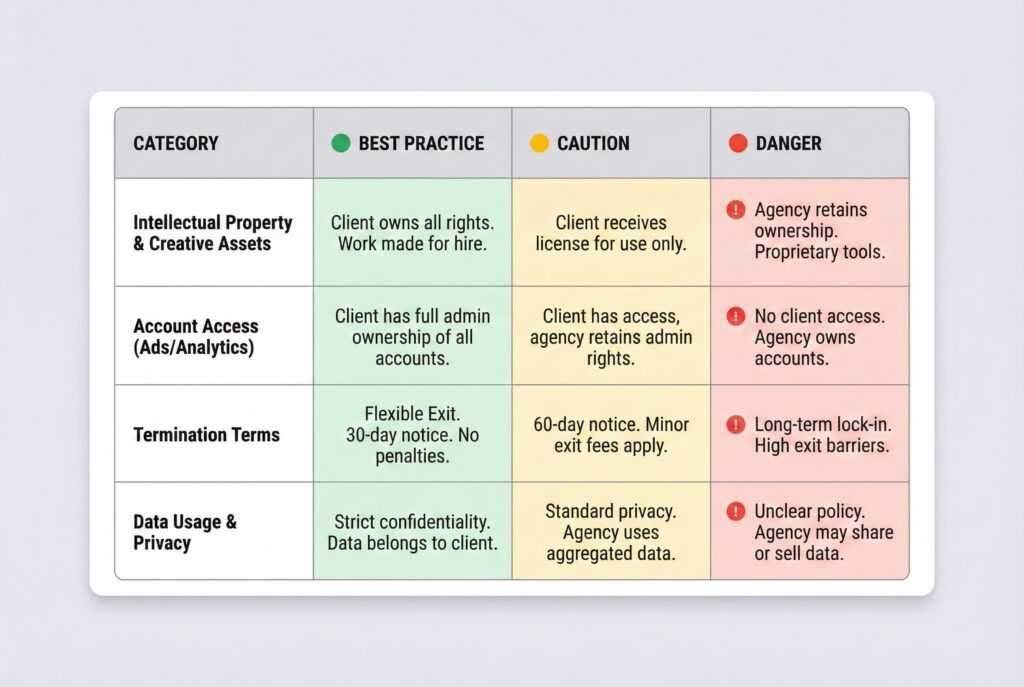
The standard should be: you own all accounts. The agency gets added as a manager or admin. When the relationship ends, you remove their access and keep everything.
The Auto Renewal Trap
Marketing contracts love auto-renewal clauses with 60-90 day notice windows. Miss the window and you’re locked in for another year with an underperforming vendor.
Negotiate for termination with 30 days notice. And make sure the contract addresses data portability; meaning when it ends, they help you transfer everything to your control.
Related: What ownership looks like with us
The Compliance Risks Your Agency Might Be Creating
Summary: Florida Bar Rules 4-7.11 through 4-7.22 require: (1) name of at least one lawyer or firm, (2) city/town/county of real office, (3) disclosure if cases referred out. You cannot use “Expert” or “Specialist” without Board Certification. ABA Rule 7.3 prohibits direct solicitation — geofencing emergency rooms may cross this line. The agency doesn’t lose their license if ads violate Bar rules — you do.
For a regular business, deceptive advertising means a fine. For a lawyer, it means Bar complaints, suspension, or disbarment. Your agency needs to understand this isn’t regular marketing.
The Mandatory Disclosures
Per Florida Bar Rules 4-7.11 through 4-7.22, every advertisement needs:
- Name of at least one lawyer or the firm
- City, town, or county of a real office
- Disclosure if cases will be referred out
Agencies often skip these on social media ads because of space constraints or aesthetics. That’s not their call to make.
The “Expert” Trap
Agencies love superlatives; “Expert,” “Specialist,” “Authority.” But in legal advertising, you can’t call yourself a specialist unless you’re Board Certified. If your agency’s copywriter labels you a “Car Accident Expert” and you’re not Board Certified, you’re liable for the ethics violation.
The Solicitation Line
ABA Rule 7.3 prohibits direct solicitation of specific people known to need legal services. Some agencies push gray-hat tactics like geofencing emergency rooms to serve ads to accident victims. That’s skating the line of prohibited solicitation, and if it crosses, it’s your license on the line, not theirs.
Related: How we handle Bar compliance in SEO content
What Good Reporting Actually Looks Like
Summary: Four questions for monthly agency meetings: (1) What’s our cost per signed case? (2) What’s our impression share? (3) How do you define a “conversion”? (must be completed form or 60+ second call, not button click), (4) What didn’t work this month? An agency claiming everything works perfectly is hiding failures.
The monthly report should answer these questions:
- What’s our cost per signed case this month? If the agency can’t answer this, they’re not tracking revenue.
- What’s our impression share? This tells you what percentage of eligible searches showed your ad. Low impression share often means budget is capped and you’re missing available market share.
- How do you define a “conversion”? Make them be specific. A conversion should be a completed form or a phone call over 60 seconds — not a button click or page view.
- What didn’t work this month? An agency that claims everything is working perfectly is hiding something. Good marketing requires testing, and testing means some things fail. You want an agency that shares failures as learning opportunities.
The Red Flags Checklist
Summary: Immediate termination triggers: (1) Agency owns your accounts or data, (2) “Expert” claims without Board Certification, (3) Missing required disclosures. Performance red flags requiring 90-day improvement plan: CPL over $2,000 without signed cases, no attribution tracking, generic AI content without lawyer review, agency takes days to respond.
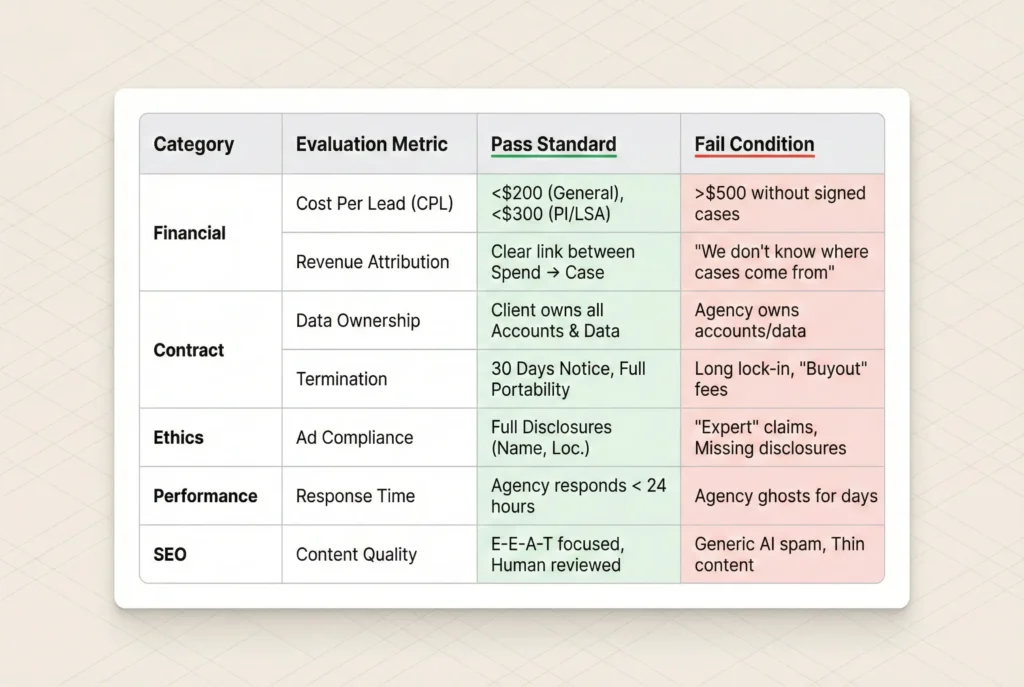
Financial Red Flags:
- Cost per lead over $2,000 without corresponding signed cases
- “We don’t know where cases come from”
- No tracking between spend and revenue
Contract Red Flags:
- Agency owns accounts or data
- Long lock-in periods
- Buyout fees to access your own assets
Compliance Red Flags:
- “Expert” claims without Board Certification
- Missing required disclosures
- Tactics that feel like solicitation
Performance Red Flags:
- Agency takes days to respond
- Generic AI content without lawyer review
- Can’t explain what’s working and what isn’t
The Bottom Line
Summary: Four rules for managing marketing agencies: (1) Track to signed cases, not leads; if you can’t calculate cost per signed case, you’re guessing; (2) Own your assets; accounts, data, website, content; (3) Understand compliance stakes; you lose the license, not them; (4) Demand transparency; good agencies educate, bad agencies hide behind jargon. Non-negotiable termination triggers: compliance failures, data ownership issues.
Your marketing agency has two of your most critical assets: your money and your reputation. Most firms treat this relationship too passively, accepting whatever reports the agency sends without questioning whether those numbers connect to actual business results.
The fix is simple but requires discipline:
- Track to signed cases, not leads. If you can’t calculate your cost per signed case, you’re guessing.
- Own your assets. Your accounts, your data, your website, your content. If you can’t fire your agency without losing everything, you don’t own it.
- Understand the compliance stakes. The agency doesn’t lose their license if your ads violate Bar rules. You do.
- Demand transparency. A good agency educates you. A bad agency hides behind jargon.
If your current agency fails on compliance or data ownership, those are non-negotiable. Move to terminate, but secure access to your assets first.
If they’re failing on performance metrics, a 90-day improvement plan with clear targets is reasonable. But if the numbers don’t move, cut them.
Marketing is the engine of your firm. Make sure your mechanic is honest, skilled, and accountable.
Related: More questions to ask before hiring – Learn more about how we work
Source
Industry benchmarks cited in this article are drawn from the Florida Bar Advertising Rules and aggregated 2025 US legal marketing data from National Law Review, Clio Legal Trends Report, and LocaliQ Search Advertising Benchmarks.